By
By 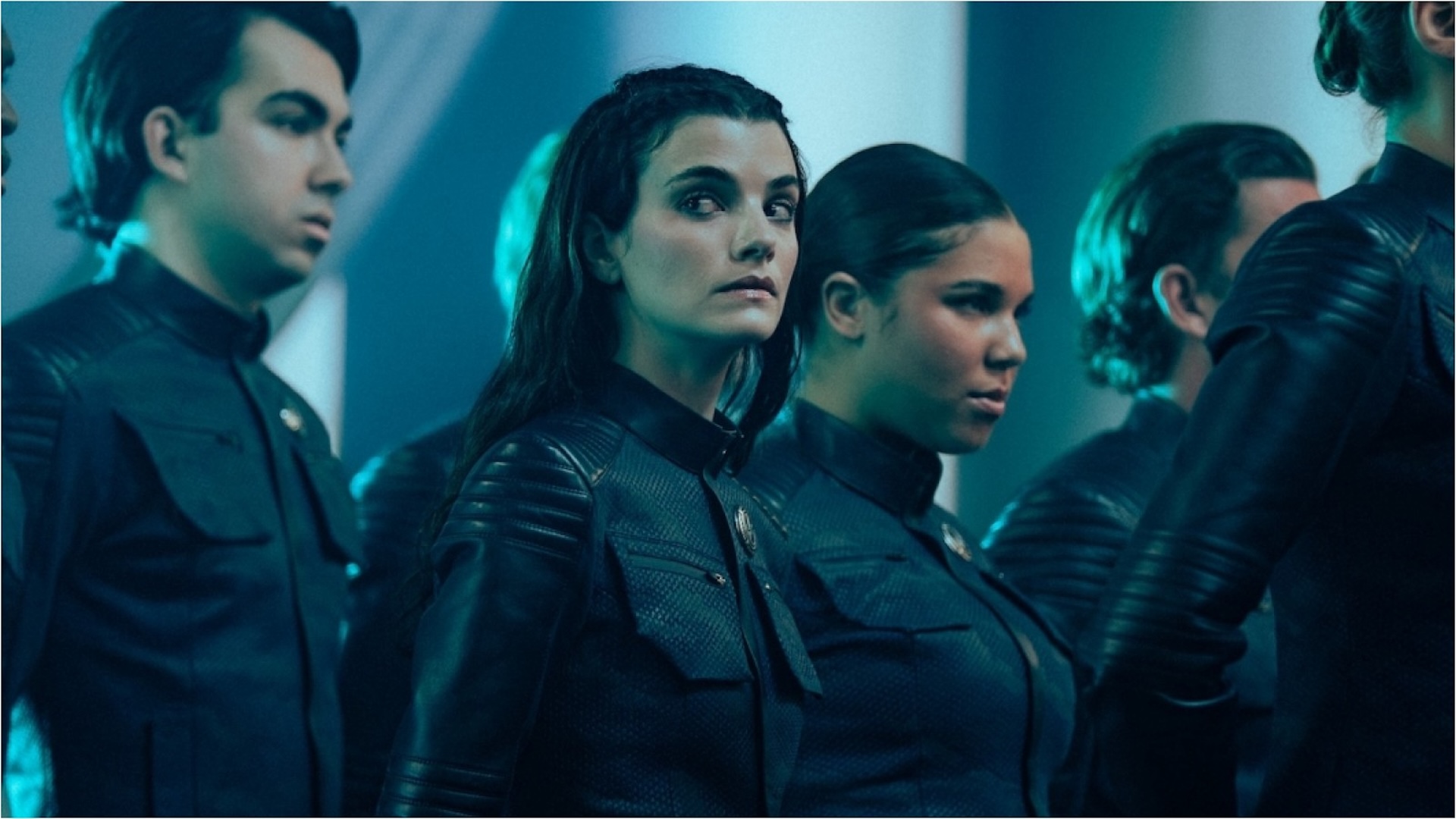
The following contains spoilers for Star Trek: Starfleet Academy episode 6.
Star Trek: Starfleet Academy’s “Come, Let’s Away” is an hour that has a whole lot going on. From bringing back Paul Giamatti’s colorful antagonist, Nus Braka, to sending the cadets on a training mission that takes a deadly turn, the episode contains real stakes and genuine consequences, of a sort that will resonate well past its end credits. Chancellor Ake gets outsmarted by Braka, a bunch of experimental tech gets stolen, a horrifying new alien species is introduced, and both an instructor and a student are killed. It’s kind of a lot to take in.
In the midst of all this, it might seem strange that this hour also represents a significant coming-of-age moment for cadet Tarima Sadal, a Betazoid empath who manages to rescue her classmates by essentially obliterating a squadron of Furies with the sheer force of her mind. Choosing to remove the neural inhibitor implant that’s been suppressing the full extent of her telepathic abilities, Tarima risks her life by finally unleashing the power she’s worked for most of her life to keep in check. And for actress Zoë Steiner, it’s a profound moment for her character, who must learn not only to accept but to embrace the truth of who she is.
“This was a huge episode for me, and it was such a gift as an actor to go to that depth emotionally,” Steiner tells Den of Geek. “I think, for Tarima, we really see in [this episode] her reckoning with and coming to terms with her power. We can obviously talk about Betazoids and their sensitivity, and their empathic abilities. But I think that sometimes [we] forget about what that means in terms of how much power is truly within her. And we see her really coming to terms with that, and being able to see her sensitivity as a strength, even like a superpower rather than a weakness.”
Starfleet Academy is a show that’s full of coming-of-age arcs, which makes sense given its setting, subject matter, and cast full of young cadets finding their way in the world. And while Tarima’s story looks quite a bit different from, say, Jay-Den Kraag’s or hologram student Sam’s, it’s no less impactful. Not the least of which reason being that it comes with a body count, but also because it ultimately asks the young Betazoid to embrace a new way of looking at herself in the world.
“She has her neural inhibitor, and it’s designed to protect her, and for a good amount of time it has,” Steiner says. “But, and people all have things like this in our own lives, the idea of things that we do, or behaviors [we] engage in that serve their purpose for a while, and then they don’t anymore. On the contrary, they might even be holding us back. And in that scene, she knew what she had to do; that inhibitor had to come off to get access to the sheer amount of power that was required. That protective mechanism had to go.”
Through Starfleet Academy’s six episodes to date, we’ve largely seen Tarima through the lens of her romance with fellow cadet Caleb Mir. Initially introduced as a flirt with serious playboy vibes, it’s through his relationship with Tarima that we’ve been able to see his more human and likable depths.
“Caleb has had to be so guarded his whole life, but [Tarima] just bypasses all the boundaries he’s had to set up without even trying,” Sandro Rosta, who plays Caleb, says. “She has so much capacity to understand him and can kind of feel and sense everything going on inside [him]. And she does that from day one. So there’s a huge amount of release that he gets emotionally, and a huge amount of safety that he feels when he’s around her. And I think that’s something that’s very new to him.”
In this episode, it is because of the strength of Caleb and Tarima’s connection — of both the mental and the physical variety, since one clearly informs the other — that she’s able to mindspeak with him and help save the students trapped on the wreckage of the Miyazaki.
“From the very beginning, when we first meet them — and we see this reflected particularly in the aquarium scene with the whales — Caleb really represents freedom, and that’s something that Tarima really yearns for,” Steiner says. “She just hasn’t really allowed herself to or hasn’t been in a position to experience that yet. Being behind the psionic barrier on Betazed, there’s that literal wall up around her, and with her abilities, it brings her a lot of shame and [she has] emotional walls up as well. So I think when she meets Caleb, a whole new world of possibilities opens up for her.”
“Come, Let’s Away” ends on something of a cliffhanger — or at least, with a lot of plot threads still to be dealt with. While most of the cadets make it safely back to the Athena (Rip, poor B’avi), Braka has escaped with a shipful of experimental Federation tech and Tarima herself in a coma. While we all know that she’ll wake up eventually, it seems equally safe to assume that she’ll be greatly changed by this experience when she does so. And she and Caleb will have to navigate what her newly enhanced abilities mean for their relationship going forward.
“I think that what we’ll see is that there are a lot of things that Caleb feels when he discovers this potential that Tarima possesses and what she’s capable of,” Rosta says when asked about his character’s reaction to his girlfriend’s abilities. “If anything, it deepens whatever emotions he has for her in a sense of respect, admiration, and all these things. But it kind of knocks him off his center, if you will. If you’re in love with someone and you realize that they have this incredible capacity to be utterly destructive, and that yes, it could be used for good, but also it’s something that is just so unexpected. And our relationship has been portrayed as very realistic. We don’t shy away from the complicated emotions that come up within him. And I think that, as the series progresses, it affects him in a very… I would say that it’s complex, but it’s also a deepening.”
And as for Tarima, she will have to face her own inner demons when it comes to who she is and what she’s capable of using her abilities to do. But to listen to Steiner talk, it’s ultimately a good kind of growth.
“With some difficulty. With great difficulty, actually,” she says, when asked about how Tarima will navigate life after her inhibitor. “I think she has a lot of shame about her abilities, and there is some fallout after what happens in episode six. And it’s just great. It’s just wonderful writing to explore that and see her navigate the shame and come out the other side.
New episodes of Star Trek: Starfleet Academy premiere Thursdays on Paramount+, culminating with the finale on March 12.
The post Star Trek: Starfleet Academy’s Zoë Steiner Discusses an Uninhibited Tarima appeared first on Den of Geek.