By
By 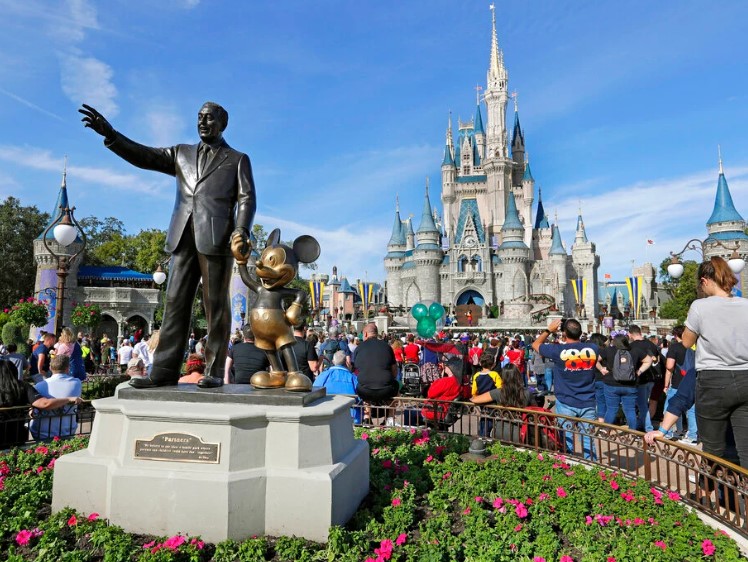
Last week, The Walt Disney Company officially anointed Josh D’Amaro as its next CEO, finally ushering Bob Iger back into whatever cryogenic chamber Disney keeps him in between emergencies. On paper, this is supposed to mark a bold new era for the Mouse House.
Yet if you look really closely, and think about this logically, there is also a danger that it could be rearranging deck chairs on the Titanic, if the Titanic charged you $209 just to step onboard.
What do we mean? Well, D’Amaro does inherit something of a corporate mess of floundering movies and streaming services hemorrhaging cash, but the real crisis, one that the American family can actually feel, is at Disney’s American theme parks. It’s a crisis of Disney’s own making.
An Obituary For The Middle Class Vacation
Some commentators believe that D’Amaro’s honeymoon period will last approximately five minutes. Because for millions of families out there who are supposed to be Disney’s customers, he isn’t “the new CEO.” He’s the guy who’s supposed to fix a theme park experience that has become joyless, grotesquely overpriced, and downright hostile.
Once upon a time, a Disney vacation was an aspirational but achievable American tradition. You saved up. You drove or flew to Florida. You took the kids. You made memories. Walt Disney himself explicitly built his parks for families, especially working and middle-class ones.
That version of Disney is completely dead at the parks.
As of 2026, the so-called “Disney Tax” has reached comically horrifying proportions. The relentless stacking of price hikes, surcharges, app-based toll booths, and pay-to-play conveniences has crossed into complete parody.
For the first time ever, a single-day, single-park ticket to Magic Kingdom now exceeds $200, topping out at $209 during peak periods. That’s per person. For one park. For one day. Add taxes and parking, and a family of four can torch nearly $1,000 before you even see that fucking castle.
Animal Kingdom was historically a “budget” option, and that now starts at $119. Congratulations, you’ve paid triple digits to look at some scaffolding and maybe a giraffe. Given the amount of construction underway at some of the parks, as one online commentator wrote: “Why should I pay 100% of the money for 75% of a theme park?”
This gets even worse when you factor in the two-tier horror that is the Lightning Lane. Basically, you pay extra or spend 90% of your day standing in a queue like a peasant. The Lightning Lane system is the perfect metaphor for what the parks have become now: a caste system with mouse ears.
Lightning Lane Premier Pass lets guests skip lines without living on their phones, like FastPass used to do for free, but this iteration costs up to $449 per person. That’s not a typo. A wealthy family of four can drop $1,800 and waft around the parks without having to trouble themselves being anywhere near those unspeakable poor people in their lines.
Now, I am as far away from a Communist as it is possible to get, but this all feels completely wrong, and totally against Walt’s ethos.
Even the “standard” Lightning Lane Multi Pass can now hit $45 per person per day if you want anything resembling a pleasant experience. Bearing in mind that the parks are considered completely undoable and unbearable without some kind of line-skipping turbo addition.
This is not “premium.” This is ransom.
Alienated Everyman.
An article in the Los Angeles Times also picked up on this middle-class erasure from the happiest place on Earth. Hotels once marketed as “Value Resorts” like Pop Century now routinely exceed $300 a night. Meanwhile, a quick-service meal averages $20–$24 per person for glorified cafeteria food.
Take a moment to process that. A burger and fries kept warm under a lamp, retrieved yourself on a plastic tray, then eaten on a barstool leaning on a wooden shelf, is up to $24.
All the perks that once justified the cost, such as the free airport transportation and the free FastPass, have all been stripped away.
So guests are paying more for less while walking through parks partially closed for construction until 2027.
Attendance hasn’t collapsed. Instead, something worse has happened.
Families are going less often, or not at all, while the parks are increasingly dominated by unbearable Disney Adults. You know the type. No kids. Annual passes. Loungefly backpacks. Loud opinions about ride overlays. Treating what used to be a family destination like a lifestyle cult.
Disney hasn’t replaced families with new families. It’s replaced them with obsessives and influencers who will tolerate any price hike as long as they can still post about it.
That’s not a healthy ecosystem. It’s a bubble.
About That “New” CEO
Here’s the part Disney would rather you ignore: Josh D’Amaro didn’t inherit this mess. He helped create it.
From 2017 onward, D’Amaro bounced rapidly through top park positions. President of Walt Disney World, President of Disneyland, then Chairman of Disney Experiences during the Chapek era. That role put him in charge of attractions, pricing, merchandise, cruises… the entire global theme park machine.
Dana Walden & Josh D’Amaro
In other words, a lot of this happened, or was at least allowed to continue, on his watch.
So when Disney asks fans to trust him to “restore the magic,” what they’re really saying is: Please believe the arsonist will now handle fire safety.
First of all, Disney needs to remember who Disneyland and Walt Disney World were built for. Following this, they need to simplify the app nightmare, restore meaningful resort perks, and use Disney’s $60 billion expansion plan to actually relieve crowd pressure instead of just monetizing it.
But that would require a philosophical shift Disney hasn’t shown any interest in making, and didn’t in any way when he was in charge of parks and experiences.
Because the real question isn’t whether Disney can build bigger lands or shinier rides. It’s whether the company still believes its parks should be for ordinary Americans, or only for the wealthy, the obsessed, and the algorithmically sponsored.
Walt Disney built a place where families could escape reality for a day. Modern Disney has built a place where reality follows you everywhere and then charges you for it.
The post Disney Has A Big Parks Problem To Solve appeared first on Last Movie Outpost.