By
By 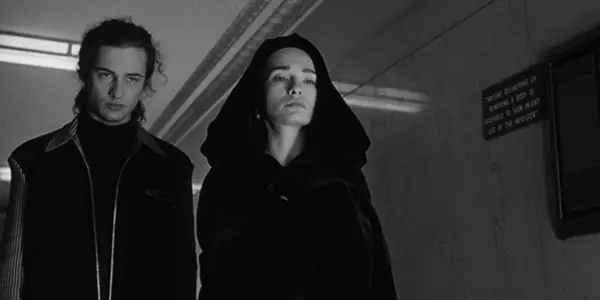
Ever since Count Orlok stalked through the shadows of the 1922 German Expressionist masterpiece Nosferatu, filmmakers and audiences alike have been under the spell of the vampire. Yet among all the variations on the vampire legend that have haunted our screens over the past century, Michael Almereyda’s Nadja stands out as one of the most memorable. A hypnotic mix of the 1936 Universal horror film Dracula’s Daughter and Andre Breton’s 1928 surrealist novel Nadja, the film stars Elina Löwensohn as a lonely and disenchanted vampire in New York who thinks she’s found a new lease on undead life after Van Helsing finally kills her overbearing father, Count Dracula. Executive produced by David Lynch, who paid for the film out of his own pocket when funding fell through (and also has a delightful cameo as a morgue attendant), Nadja has been newly restored in 4K by Arbelos and Grasshopper Films from the original 35mm print that premiered at the Toronto International Film Festival in 1994.
The Loneliness of the Long-Suffering Vampire
When we first meet Nadja (Löwensohn), she’s waxing philosophically to a man she’s met in a bar about why she prefers life in New York to that of her native Europe; moments later, she’s ripping his throat out with her teeth and drinking him dry. Speaking in a heavily accented monotone and clad in a black cape, Nadja does indeed resemble the vampires of legend—but in the city that never sleeps, that merely means she’s just one of many oddball denizens of the dark, a figure of eerie and erotic fascination but not necessarily fear. You know these kinds of New Yorkers; they might even be vampires, though perhaps not the literal, blood-sucking kind.
source: Arbelos Films
When Nadja hears that Van Helsing (Peter Fonda) has killed her father, she and her servant, Renfield (Karl Geary), visit her estranged twin brother, Edgar (Jared Harris), who is sick in bed in the care of his nurse, Cassandra (Suzy Amis), to share the news. But their reunion is complicated by Van Helsing’s determination to kill Nadja as well, especially after she seduces Lucy (Galaxy Craze), the wife of Van Helsing’s nephew, Jim (Martin Donovan); now, only Nadja’s destruction can save Lucy from an eternity of undead servitude.
Bela Lugosi’s Dead…Elina Löwensohn Lives
Nadja was shot entirely in black-and-white, partly on 35mm film stock and partly on a Fisher-Price Pixelvision camcorder; the 35mm is used to represent the view of the living, while the Pixelvision represents the view of the undead, caught as they are in a blurry, liminal space between this world and the next. Indeed, the Pixelvision scenes are so…well, pixelated that it can be almost impossible for the audience to comprehend what is happening in these moments, transforming the already hallucinatory film into a downright delirious experience. It’s difficult to resist the urge to strain your eyes during these sequences, but if you don’t, you’ll end up with an exhaustion headache by the end of the film, so just sit back and enjoy the quirkiness.
source: Arbelos Films
One of the film’s biggest strengths is its deadpan humor, in which the characters frequently spout bizarre lines that are hilarious to the audience but very serious to them; they’re seemingly unaware of how ridiculous everything happening to them is, because in their world, it isn’t ridiculous at all. When introducing Renfield to others, Nadja bluntly states, “Renfield lives with me. He’s my slave.” When Lucy, talking about her pet tarantula, says, “I tried to teach him French, but he wasn’t interested,” Nadja responds, “Maybe he has a learning disability.” Löwensohn, in particular, excels with this kind of material; her dry delivery practically elevates these lines to comic poetry. It helps that she also has a natural charisma that many of the film’s supporting actors are unfortunately lacking—though not Fonda, who manages to make talking about staking vampires in the heart over a late-night diner sound believable, if not necessarily normal.
Despite its edgy, artistic aesthetic—complete with a soundtrack featuring Portishead and My Bloody Valentine—Nadja is less concerned with the glamour of eternal life than with the existential dread of it all, especially the exhaustion that comes with living long enough to see history inevitably repeat itself. Nadja doesn’t want to die, but she doesn’t want to keep living this same old undead life, either; the end of her father symbolizes a new beginning for her, and she won’t let anyone, especially Van Helsing, take that away from her—not when she’s been waiting centuries for the chance.
source: Arbelos Films
Conclusion
A time capsule of a certain era of indie film experimentation, Nadja might lack the gloss of later vampire films with larger budgets, but that’s part of what makes it such a fun watch.
The new 4K restoration of the director’s cut of Nadja begins screening at BAM in New York on February 6, 2026.
Does content like this matter to you?
Become a Member and support film journalism. Unlock access to all of Film Inquiry`s great articles. Join a community of like-minded readers who are passionate about cinema – get access to our private members Network, give back to independent filmmakers, and more.