By
By 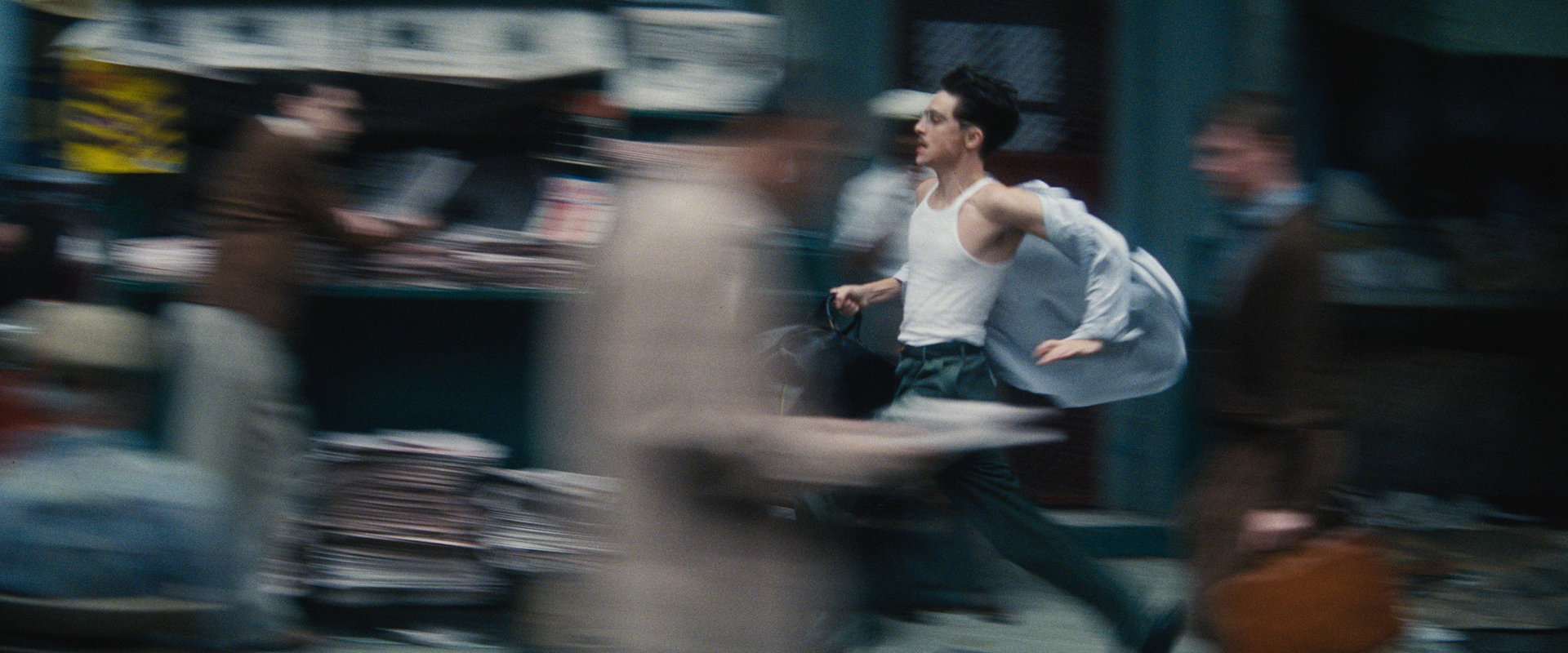
Marty Supreme (2025)
Dream Big
There’s something deeply fitting about Josh Safdie making his first major solo swing with a film about table tennis — a sport built on rhythm, panic, instinct, and breathless momentum. After all, if anyone in modern cinema understands relentless motion, it’s Safdie. The filmmaker behind Good Time (2017) and Uncut Gems (2019) has always treated anxiety like an engine, and with Marty Supreme, he serves up another high-speed, sweat-soaked story where ambition is both the paddle and the ball.
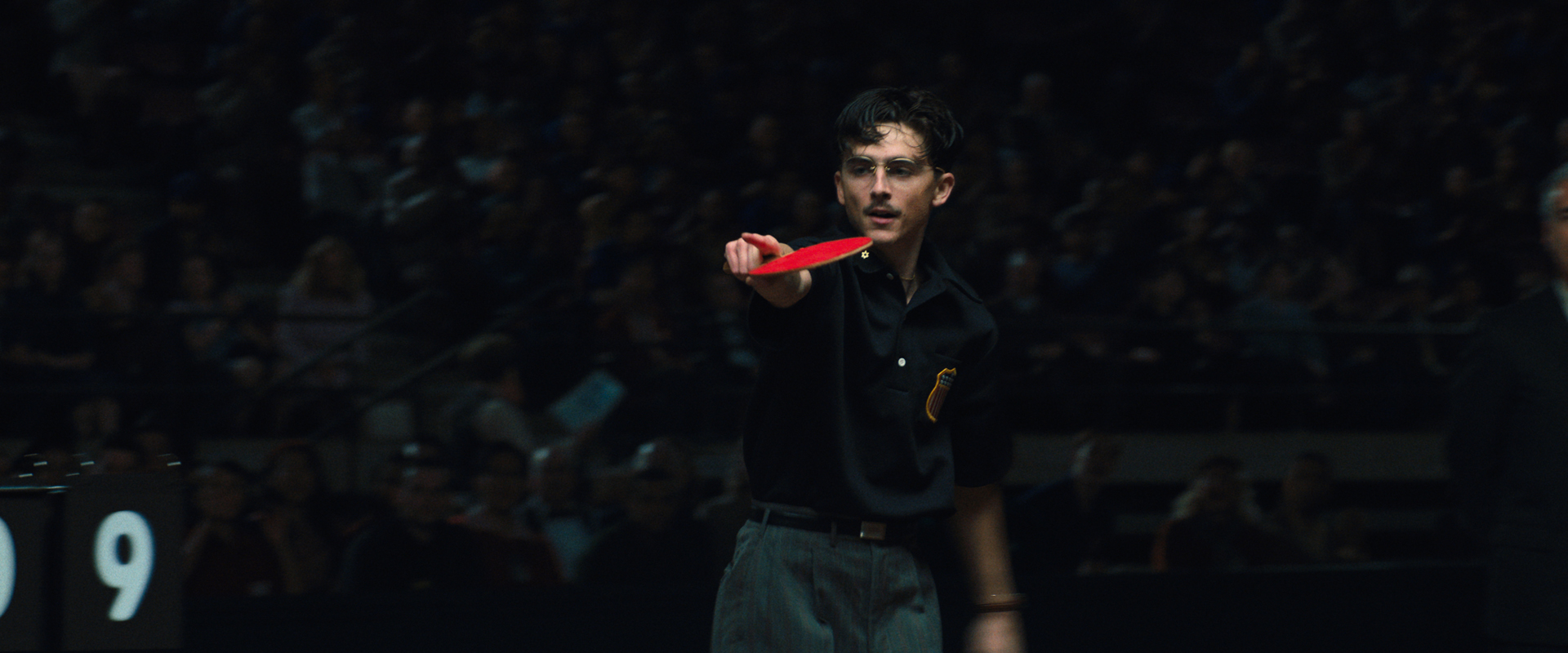
Set in 1952 New York, Marty Supreme follows Marty Mauser (Timothée Chalamet), a young ping-pong hustler with a chip on his shoulder and a dream too big to keep quiet. Marty isn’t just trying to win matches — he’s trying to win a life. Loosely inspired by real-life champion Marty Reisman, Mauser is the kind of scrappy operator Safdie loves: fast-talking, constantly calculating, always one misstep away from collapse. He moves through smoky clubs, backroom tournaments, and neon-tinged city nights like a man chasing something just out of reach. The film isn’t interested in the clean rise of a sports hero. This is table tennis as street survival — where every rally feels like a negotiation with fate. And from the opening moments, Safdie makes it clear: this isn’t going to be a gentle warm-up. This is a match played at full speed.
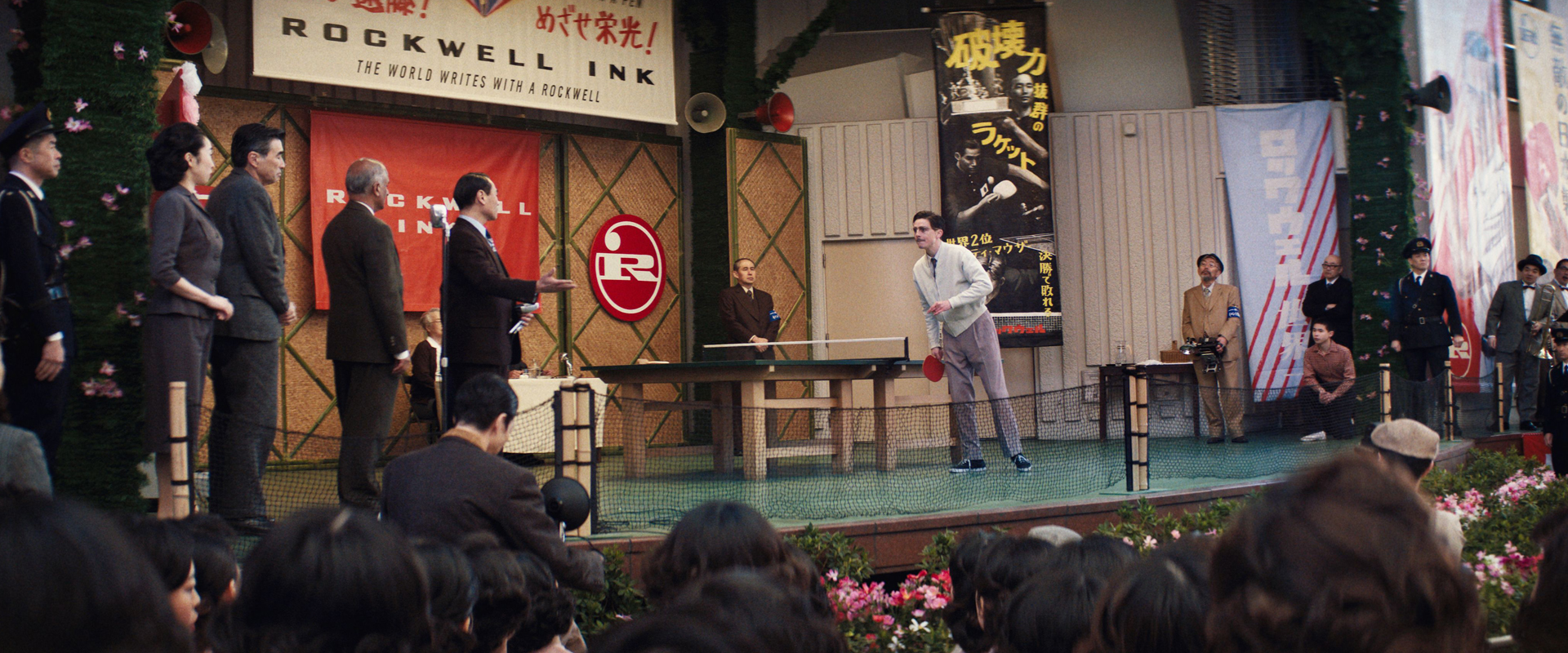
The story unfolds with a breathless, forward-driving energy. Marty scrapes by on hustle and bravado, using ping-pong not simply as sport but as currency — bouncing between off-the-books games and underground matches where pride and money sit on the same table. His gift is undeniable, but so is his recklessness. As his reputation grows, so do the stakes, and what begins as a street-level grind gradually pulls Marty into bigger rooms and stranger circles — all leading toward an almost mythic goal: getting himself to Japan, where a looming showdown with reigning champion Koto Endo (Koto Kawaguchi) represents both the ultimate test and the promise of legitimacy. Marty Supreme becomes, in many ways, a frantic race toward Tokyo, toward the idea that one match abroad might finally make his name mean something. Safdie structures the film like a rally: quick exchanges, sudden turns, no time to reset. The narrative doesn’t pause for comfort. It keeps returning the ball, again and again, forcing Marty — and the audience — to stay alert. It’s thrilling, exhausting, and completely absorbing.
Co-written by Safdie and Ronald Bronstein, the screenplay carries that familiar Safdie texture: characters who speak like they’re running out of oxygen, dialogue that feels half-improvised but razor precise, and a world where every choice has weight. At its core, Marty Supreme is about obsession — the idea that wanting something badly enough becomes its own kind of trap. Marty’s drive is inspirational, yes, but also self-consuming. The story explores the American Dream in its most lurid form: not as noble aspiration, but as constant striving, constant motion, constant hunger. It asks: what happens when you can’t stop swinging? When you don’t know how to live unless you’re chasing the next point?
Hustling at full speed, paddle optional.
And then, quietly, in its final stretch, the picture introduces something softer — a reminder that life doesn’t always move at the pace of a rally. It gestures toward the idea of legacy, of what remains when the noise fades, and whether Marty’s relentless chase can ever make room for something beyond himself. It’s a small, human punctuation mark at the end of all that madness — a moment that reframes everything not as triumph or defeat, but as continuity. Safdie doesn’t judge Marty. He simply watches him spiral with empathy and intensity, letting the themes emerge naturally through action rather than speechifying. And by the time the credits roll, you realize the movie has been asking something even bigger than who wins. It’s been asking what it all adds up to once the match is over.
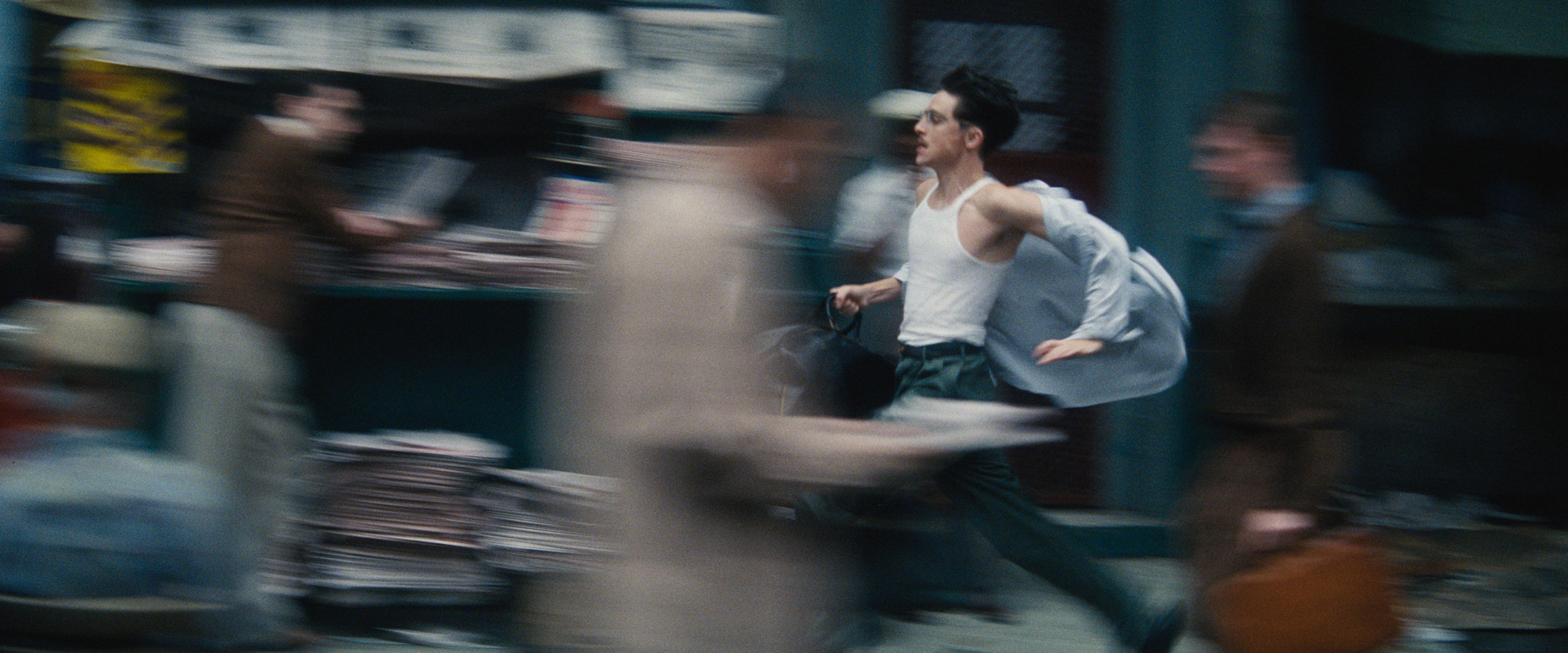
If there’s one word that defines Marty Supreme, it’s relentless. Safdie directs with the urgency of someone allergic to stillness. Scenes overlap, tensions stack, conversations collide. Even quiet moments feel like they’re vibrating beneath the surface. The movie moves like ping-pong itself — rapid, reactive, unpredictable. You don’t watch it so much as you keep up with it. And yet, unlike some movies that confuse chaos for depth, Marty Supreme always feels deliberate. Safdie knows exactly where the ball is going, even when it looks like it’s spinning out of control.
Visually, the picture is stunning. Shot primarily on real 35mm Kodak film stock by legendary cinematographer Darius Khondji, Marty Supreme has a texture that feels tactile — grainy city streets, warm interior shadows, sweaty close-ups that practically glow. 1950s New York is rendered not as nostalgic postcard, but as a city with a pulse: grimy, golden, cramped, alive. The camera often sits uncomfortably close to faces, capturing every flicker of desperation and desire. It looks excellent — the kind of movie where you can almost smell the room.
Every glance feels like a serve.
One of the film’s most striking choices is its synth‑rich score by Daniel Lopatin — the electronic artist also known as Oneohtrix Point Never — whose work gives the movie much of its kinetic, pulsing energy. Safdie pairs Lopatin’s original music with deliberately anachronistic needle drops — layering ’80s songs over a ’50s setting in ways that create a jolt that somehow works beautifully. Pop classics like Tears for Fears’ “Change” and “Everybody Wants to Rule the World,” Peter Gabriel’s “I Have the Touch,” and Alphaville’s aching “Forever Young” all appear in the film’s soundtrack. It shouldn’t fit — but it does. The soundtrack becomes a kind of emotional bridge, modernizing Marty’s feelings even as the world remains period‑specific. The effect is energizing, electric, sometimes even haunting, keeping the film from ever settling into comfortable “period drama” mode. Like Marty himself, the movie refuses to play by the expected rules.
Timothée Chalamet anchors the picture with one of his most frantic and physical performances to date. His Marty Mauser is charming, slippery, cocky, vulnerable — a young man paddling furiously against the current. Chalamet understands that Marty’s confidence is often just panic wearing a nice suit. Gwyneth Paltrow, in a notable return to acting, brings poise and edge as Kay Stone, a wealthy retired actress and socialite whose presence feels both glamorous and slightly untouchable. Odessa A’zion is also solid as Rachel Mizler, Marty’s sharp, complicated romantic foil, injecting the story with friction and humanity. Her dynamic with Marty is messy, lived-in, and never predictable — a relationship that feels like its own kind of rally.
Then there’s Kevin O’Leary — yes, that Kevin O’Leary — who surprisingly holds his own as Milton Rockwell, Kay’s husband and a wealthy pen magnate, whom Marty encounters as his talent starts carrying him into higher, more sophisticated company. Rockwell isn’t a simple benefactor; he’s a symbol of the moneyed world Marty is trying to break into, where opportunity always comes with a shadow of control. O’Leary’s real-life sharpness gives the character an odd, imposing authenticity — the kind of presence that feels almost too real to be fiction. Luke Manley makes a strong impression as Dion Galanis, Marty’s friend and early would-be partner — the kind of hustler-adjacent New York kid who believes in Marty’s dream almost as much as Marty does, even when the whole thing starts to spin out of control. Tyler the Creator appears as Wally, a taxi driver pulled into Marty’s chaotic trajectory, bringing the kind of effortless charisma that reminds us why musicians often work so well in Safdie films: they carry rhythm, and this film is all rhythm. The ensemble, stacked with recognizable faces and unexpected cameos, feels like a crowded city street — hectic, unpredictable, and somehow perfectly alive.
In short: Marty Supreme is a match worth watching, Josh Safdie in peak form — an anxious, exhilarating, strangely beautiful ride about ambition, obsession, and the cost of never slowing down. It’s a sports film, but not really. It’s a hustler film, but not exactly. It’s a portrait of a man who can’t stop moving, because stopping might mean facing himself. Safdie directs like a player mid-rally: instinctive, aggressive, always pushing forward. The film keeps returning serve, faster and faster, until you realize you’ve been holding your breath the whole time. And when it finally ends, it doesn’t feel like the match is over. It feels like Marty is still playing somewhere, chasing the next impossible shot.
4.5 / 5 – Highly Recommended
Reviewed by Dan Cachia (Mr. Movie)
Marty Supreme is distributed by A24