By
By 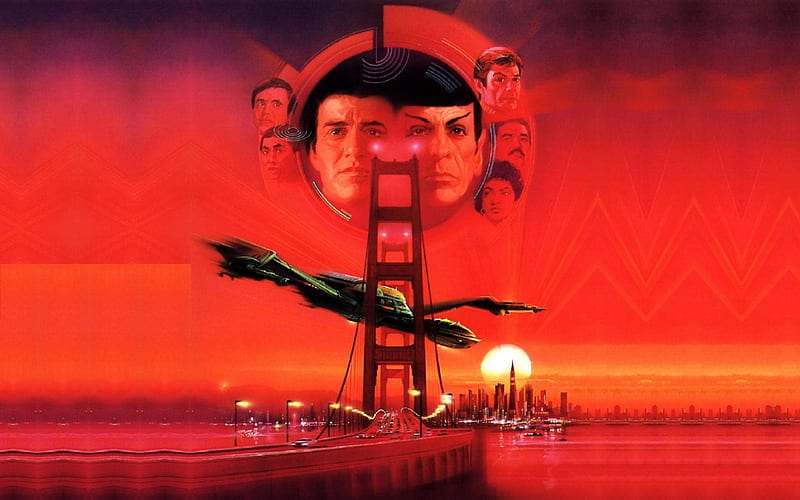
Title: Star Trek IV – The Voyage Home
Release Date: 11/26/1986
Plot Summary
Three months after rescuing their shipmate, Captain Spock, Kirk and the fugitive crew of the Enterprise prepare to head back to earth to face the consequences of their actions.
The situation has gotten sensitive as the Klingons refuse any peace negotiations as long as Kirk lives. Sarek does his best to speak on their behalf but Starfleet has already made its decision.
Unbeknownst to them, a probe is headed to earth, beaming a signal that no one on earth can decipher. It’s power drains starships of their power.
Spock joins Kirk and the rest of the crew on the Klingon ship they brought home from Genesis, now repaired and ready for the trip. He wants to offer testimony in all this.
On their way to Earth, they receive a general distress call warning all ships to stay away. The probe has arrived and is creating havoc all across the planet.
Storms, temperature drops, flooding, and there’s nothing the Federation or Starfleet can do as every power system they have is drained by the probe.
Kirk and Spock deduce that the signal seems to be directed at the oceans. Playing back the signal as if it was underwater finds a match to an extinct whale species, humpbacks.
Spock suggests they go back to the past and retrieve some whales. Kirk agrees and they begin planning for a slingshot around the sun, which is how they went back in time back in the old days with the Enterprise.
They end up back in 1980’s San Francisco. Unfortunately not without some problems. The dilithium crystals are degrading, they need to build a whale tank on the ship with 20th century materials, and last but not least, they have to find a pair of whales. It does take two to tango, after all.
Spock theorizes that they could regenerate the crystals with the energy from a nuclear fission reactor, used in many naval vessels. Uhura and Chekov go to find the reactor.
McCoy, Scotty, and Sulu attempt to hunt down what they need for a whale tank, while Kirk and Spock track down the whales from a mysterious signal they picked up upon first approaching San Francisco.
Kirk and Spock find the whales are in an aquarium, the Cetacean Institute.
There they meet Gillian Taylor, a whale biologist working to save whales from the hunting that’s still going on. She gives a tour daily showing the whales and attempting futilely to raise awareness of the problem.
Kirk and Spock take the tour to see the whales and realize what luck they have as they can just beam them in the ship from the tank. Spock however realizes that since its apparent that the whales are intelligent, taking them without their permissions would be wrong.
He decides to jump in the tank to mind meld with the whales, leading to Kirk and Spock getting kicked out.
Gillian is intrigued by them and takes Kirk out to lunch where he tells her everything. She’s skeptical but the promise of saving her whales from hunting is too enticing.
The whales are getting too big for the tank and they will be set free the next day, accelerating Kirk’s timeline.
Meanwhile Scotty and McCoy are able to procure some plexiglass for the whale tanks by giving away the formula for transparent aluminum while Sulu is able to borrow a helicopter for transporting it.
Uhura and Chekov sneak aboard the naval ship, poetically turning out to be the Enterprise, to gather what they need from the reactor. Uhura is able to take the collector and beam out but there isn’t enough power and Chekov gets captured.
He attempts to escape but gets gravely injured.
Gillian comes to work the next day only to find that the institute has released the whales early without telling her. Outraged, she goes back to the park where they landed the invisible ship and discovers it.
Kirk beams her aboard. Now realizing he’s telling the truth about being from the future, she tells him everything he needs to track the whales.
But Kirk is not ready to go yet, Chekov is still missing and only just now discovered to be in a hospital in critical condition. Gillian offers to help and her and McCoy join Kirk to beam over to the hospital.
There they find Chekov and McCoy heals him before the 20th century doctors can cause more damage.
They all beam back to the park and Kirk thanks Gillian, preparing to leave. Dismayed she begs to come with but Kirk refuses. She gives him the radio frequency of the tags that were placed on the whales. As he starts to beam out, she jumps in and beams up with him to the ship.
Kirk decides to allow her to come to the 23rd century. They liftoff and head to the open ocean, intercepting a whaling ship just in time to save the two whales.
After successfully beaming them aboard, they do another slingshot around the sun to end up just after they left.
The probe affects all their systems and they crash into San Francisco Bay. While Spock makes sure everyone is able to escape the sinking ship, Kirk is able to free the whales from the bay.
The whales sing, satisfying the probe which ceases its attack on Earth and goes on its way.
Kirk and his crew are brought before the Federation President and council where they plead guilty. Because they saved the planet (again) all charges are dropped except for the disobeying a superior officer, which is directed solely at Admiral Kirk.
He is reduced in rank to Captain and is assigned what he wants more than anything, the command of a starship.
That ship turns out to be a rebuilt (or recommissioned) Constitution class starship, the Enterprise. NCC- 1701-A. They are home, in every sense of the word.
Risk Is Our Business
Kirk has a lot going on but thanks to Spock being back, he’s much more laid back about it all. Or rather, he’s not troubled anymore like in II and III.
Sure, he’s all about completing the mission ahead of him but he feels like he’s already home from the start of the movie. He’s resigned to accepting his fate with Starfleet but at peace with that part.
I think he sees it all as one last go around and a chance to make one last difference.
He also uses the time to break through Spock’s issues with being brought back to life, finally losing his patience at Spock’s seeming indifference to the mission.
He really has very little arc, so to speak, but is just on task to finish the mission. He gets properly rewarded for it at the end.
Logical
Spock is doing his best but is not quite himself. It’s almost as if we reset back to TV Spock in some ways, the things he learned in the movies are simply gone.
Still he’s trying and the memory issues are starting to clear up. His journey leads him back to where he belongs, in space with this crew. Of course there are some hilarious moments along the way.
His attempts at cursing are some of the most classic humorous moments in all of Star Trek.
At the end, he has a moment with his father where Sarek admits that he might possibly have been in error in opposing his enlistment in Starfleet.
This moment between them is the equivalent of two drunk blubbering guys saying “I love you son!” “I love YOU dad!” For Sarek to ever admit an error is monumental.
He’s Dead, Jim
McCoy gets to spend time with Scotty and Sulu for quite a bit of time, instead of with Kirk and Spock as usual.
He gripes to Kirk about going back in time but has no better answer. He also seems to be far more willing to talk to Spock instead of arguing with him.
He really is snooty about 20th century medicine. Hey, man, the past was doing its best.
He gets a laugh out loud line, at least for me. When Spock is trying to help Uhura with communications he says “Excuse me Doctor, I’m receiving a number of distress calls.” To which Bones replies “I don’t doubt it.” Gets me every time.
Helm Sluggish Captain
Sulu gets to fly a helicopter. Apparently flying a starship and a Klingon Bird Of Prey translates quite well to Hueys. Who knew?
Hailing Frequencies Open, Sugar
Uhura accompanies Chekov in collecting the radiation for the dilithium crystals.
She has to beam out first and is quite upset about leaving him behind. She also is able to take the probe’s signal and adjust it so it sounds like it’s underwater, thereby setting the whole thing up.
My Wee Bairns
Scotty gets a classic moment when he picks up a mouse and patiently greets the computer with it. “Hello computer.”
Elsewhere he keeps the ship together, builds a whale tank, and recrystallizes dilithium crystals. He’s quite busy.
Nuclear Wessels
We finally get Chekov saying my chosen header for him. He and Uhura ask a ton of people in his thick Russian accent about “Nuclear Wessels” in the peak of the cold war.
He gets injured and has to be saved at the local hospital by Kirk, McCoy, and Gillian.
I Know That Guy
Majel Barret returns in a brief scene at Starfleet command during the storm. Apparently she had a bigger couple of scenes but they were cut to her displeasure.
Grace Lee Whitney also appears as Janice Rand but if you blink, you’ll miss it.
Robin Curtis appears once more as Saavik, although it’s pretty much a cameo. Thanks to the pon farr in the last movie, she was supposed to be pregnant with Spock’s child but that was never really implied and didn’t go anywhere. It does come back in the OTOY video from late 2024, so I guess it’s canon?
Jane Wyatt makes her second and last appearance as Amanda, Spock’s mother. She was last seen in Journey to Babel. It was great seeing her again and really was necessary, given all that happened to Spock.
Mark Lenard also returns as Sarek. He’s awesome as usual.
Madge Sinclair plays the captain of the Saratoga. She would return to Trek as Geordie’s mother and as an alien disguised as his mother. She was the first female Starship captain. She flew too close to an unknown probe and wrecked her ship. Women drivers, amirite?
Robert Ellenstein played the Federation President quite well. He was the son of Newark mayor Meyer Ellenstein. He did a lot of TV in the 50s and 60s. He would return to Trek the very next year in the the TNG episode “Haven.” Majel Barret was also in that episode, making it a reunion of sorts.
John Shuck plays the Klingon ambassador. He would return in Star Trek VI in a nice bit of continuity. He would return to trek in DS9 as a Cardassian Legate, Voyager as Chorus #3, and Enterprise as Antaak. He also played a Kilrathi in the Wing Commander III game, played in Babylon 5, and was Herman Munster in a Munsters revival back in the 80s. He was married to Susan Bay but they divorced and she married Leonard Nimoy. She upgraded from Klingon to Vulcan I guess.
Brock Peters plays Admiral Cartwright, taking over the fleet commander job from Admiral Morrow. Cartwright will be back in Star Trek VI. Peters returned to Trek as Benjamin Cisco’s father.
He of course was most known for his role in To Kill A Mockingbird as Tom Robinson. He also would play Darth Vader in the Star Wars radio drama, making him one of the few that were in both franchises. Well kind of, anyway.
Alex Henteloff plays Doctor Nichols, the guy who ends up inventing transparent aluminum. He looks like someone you know but can’t quite place, but really he didn’t do nearly as much as I would’ve thought. He was most knows as an attorney in Barney Miller and that was only 6 episodes. He also 4 episodes of Night Court and a ton of other 70s sitcoms.
Finally we have Catherine Hicks as Gillian Taylor. She’s enormously likable in the role and plays it well. She was most known for working with former Trek movie actor Steven Collins in the long running series 7th Heaven. She was also the mother in the first Child’s Play a couple of years after this.
Canon Maker
Transparent aluminum is introduced to the Trek universe and would be referenced a few times in the various TNG era shows.
The Enterprise 1701-A is introduced, thereby introducing the concept of continuing the Enterprise with letters after the registration. The most prominent would be the Enterprise D in TNG. It’s unclear if any other ship was granted this form of immortality, I have a feeling that the Enterprise was special in this regard. And deservedly so. The B, C, E, F, G, and J would all be introduced into canon at various points over the next 40 years.
A ship going back in time by slingshotting around the sun was first used accidentally in Tomorrow Is Yesterday and I assume on purpose in Assignment: Earth.
A parked cloaked ship is just as invisible as one in space.
Kirk mentions that the ship has a cloaking device that cost them a lot, suggesting that Starfleet hasn’t quite cracked the technology, despite stealing one back in season 3.
However Picard season 3 mentions that not only was the ship lost at sea but it took them forever to find the thing because the cloaking device switched on.
This would explain why starfleet never took advantage of it, though why they never did with the stolen one from The Enterprise Incident was never explained. It does suggest that the treaty we signed with the Romulans wasn’t in place yet.
This movie really establishes that money is not a thing in the future. Even though it was in the last movie, I’m establishing this movie is what made the whole “no money” thing canon going forward.
Whales are technically extra-terrestrial. The probe must’ve put them here somehow, why else come find them? That’s weird. They weren’t whaling ships, they were alien hunters.
Women aren’t allowed to be Starship captains as seen in the episode Turnabout Intruder. This has apparently changed with the Saratoga, the same class as the Reliant. Miranda class.
Canon Breaker
When they present the video of Enterprise exploding in the Federation council, they show the interior of what happened on the bridge, and then the exterior.
On the screen is Klingon info banner at the bottom, suggesting that the Klingons are supplying this video. But how? How did they get that video down to the interior of the bridge? Who was filming all that? The Klingon ship? Kirk stole the ship so how did they get access to it?
Scotty’s excuse that maybe this guy Nichols invented transparent aluminum is horribly lax on his part. The novel attempts to fix this but in the movie, this is so irresponsible given how fragile we see that timelines can be in past episodes of the show.
Ok, maybe they got lucky with Scotty, it’s conceivable. But Chekov leaves his gear on the Enterprise (the naval one). This isn’t some rum-dum on the street, a communicator, disruptor, and his ID badge are in the hands of the US Government.
Nothing appreciable changed the timeline? Granted, it was Klingon equipment but even so. Maybe it was X-Filed.
Back to the transparent aluminium, I’ve used a Mac Classic. I can tell you that randomly banging keys like a monkey on a typewriter doesn’t give you transparent aluminum anymore than it gives the monkey Shakespeare. There was zero attempt to make that look credible.
The Klingon ship was able to be sort of seen in the last movie while cloaked. Surely it would’ve been even more noticed on the ground and parked. Maybe they improved the cloaking device in the three months they were on Vulcan.
Back to the money thing, some try to explain away that Kirk really means “cash” when he says they are still using money but I think that’s bunk. Money is an all encompassing term with “cash,” “credits,” and “dollars” all examples of this.
It’s like saying “they are still using transportation” when he really means “they are still using cars.” Obviously Trek doesn’t use ground transportation anymore but they still use transportation.
Given that the rest of Trek did away with money in future installments, this broke all past canon where money was still a thing, even in the LAST FRIGGIN MOVIE. What, did they completely upend their economic system in the three months they were on Vulcan?
I don’t buy that because Sulu is a good starship helmsman, he can fly a helicopter. Granted, he’d be the most likely to, but it’s like a good race car driver being the only one to be able to ride a horse.
The Klingon Bridge was completely different than what it looked like in Star Trek III. I guess they decided to remodel it while they were on Vulcan.
Hey it was three months, got to do something.
Technobabble
You can collect radiation from fission reactors and re-crystallize dilithium. The reason they “can’t” in the 23rd century is more about convenience rather than being unable to.
There’s no reason to recrystallize dilithium when it’s far more cost effective to just get new crystals. It’s like trying to repair a paper plate. You can, but why?
Fission reactor fuck up Klingon Disruptors.
The 23rd century has kidney growing pills. That’s something to look forward to.
You can grab someone while transporting and get transported with them. This is probably dangerous as hell but it was established in The Enterprise Incident.
Library Computer
When Uhura and Chekov were filming the “Nuclear Wessels” scene, amusingly, this moment was shot guerrilla style. Despite rumors, it’s not true the people didn’t know they were being filmed.
They were indeed extras hired and knew it. Not certain why a hidden camera was required if that was the case. I guess for the background realism.
Vasquez rocks is used when Spock is overlooking the ship on Vulcan. This location is as much of a guest star in Trek as any other actor. This would be the last time this crew used that location but boy, there is no other location that screams Star Trek more than Vasquez Rocks.
The surreal sequence with the crews heads popping up and changing was the actual first occurence of “morphing” on the silver screen. They actually scanned all the actor’s heads and then had one change into another. Willow was the movie that got the term into the zeitgeist but in actuality, this was the first time.
A Novel Approach
Once again Vonda McIntyre returns to finish off the Genesis trilogy.
She nicely wraps up novel-only storylines as well as filling in a few blanks or minor plot holes from the movie.
In the 80s I voraciously read movie adaptations of so many different properties and Star Trek was always at the top of my lists. McIntyre in my opinion made some of the best ones with this trilogy. Most adapted the stories just fine but she took what was there and expanded on them in a satisfactory way.
No other novelist ever made additions or changes that I would incorporate into my head canon the way she did. So let’s get started.
Kirk’s Accountability
One of the things Kirk does at the end of the movie is say “On behalf of my crew, I am authorized to plead guilty.” It’s an odd way of putting it but in the novel, there is an underlying selfishness with Kirk.
He has good intentions, trying to take all the blame on himself to spare his crew the punishment he believes he should take.
There is a brief argument that goes unresolved in the beginning of the novel that leads up to the vote you see in the movie.
However later on, Sulu finally takes him to task. He tells Kirk that they all made their own decision and want to share the blame. They are proud of what they did for Spock and are proud of the loyalty they showed Kirk and each other.
Sulu finally makes Kirk realize he was taking that away from them in an effort to protect them. He was massively disrespecting their contributions.
Kirk was pretty taken aback with the realization which is why he phrased it the way he did in the movie, as if he got permission from the crew to plead guilty, even though he was their commanding officer.
He was always immensely grateful to the crew and felt very guilty in his part in putting their careers and possibly freedom in jeopardy. But he just forgot that they were people with their own agency and deserved the respect that a punishment would give them.
At the beginning of the novel, Admiral Cartwright visited Kirk on Vulcan attempting to work out a deal with him if he would come back to Earth immediately.
Kirk declines as Spock and McCoy are still needing several more sessions to fully complete the Fal Tor Pan. Cartwright is frustrated and presents him with formal warrant to return to Earth and face charges.
As he’s leaving, he runs into Saavik who attempts to argue a bit on Kirk’s behalf but Cartwright explains that there’s nothing he can do.
At this point Kirk has a lot of friends but he also has a lot of enemies. The Klingons are using the incident to make a big stink and the whole Genesis experiment is a mess.
Sulu
Sulu put a lot into fixing up that Klingon ship, along with Scotty. It kinda became his baby. He was pretty sad when it went down to the bottom of the ocean.
Saavik
Saavik didn’t just stay on Vulcan on a whim, she was assigned there at the request of Amanda to study under her. She had never been to Vulcan so it was a big deal to her.
Unfortunately, Spock did not really remember her which caused her great pain. Spock did feel like he should but whenever he tried, those memories were like a dream fading away.
As such he just simply was polite at best to her. Saavik was too proud to beg for his attention. It’s a little tragic as Spock found her as a child on Hellguard and was a surrogate father and mentor to him. While he did mostly remember the crew, forgetting her was to her like losing a parent.
She also recorded a deposition for Kirk to take back to the inquiry. She explained all the events but left out David suspecting that protomatter was why Genesis was doomed to fail.
She simply noted that it did fail. She had no wish to sully him and the rest of the scientists who had all been murdered for Genesis. What was the point?
The Probe
The Probe’s intentions are much better explained in the book. For one, the probe, or Traveler as it calls itself, is immensely old and perceives time far faster than we do.
It notices that it loses contact with the whales and immediately sets out to Earth which will only take 300 revolutions of that planet around its sun. A blink of an eye as far as the Probe is concerned. It then begins sterilizing the planet so it can reseed.
When the whales return, it’s damn surprised and wonders what happened. Where are the rest? The whales don’t know and have to make stories anew.
The probe briefly considers just continuing to finish what it started but it’s going to take so long for the planet to have a thriving whale population again and besides, there’s no way the probe could kill the whales, however few there were. So it stopped and went on its way.
Time Travel
Time travel is treated somewhat trivially in the movie, as mentioned earlier. In the book, there’s a lot more arguing about it. McCoy and Kirk have an argument where McCoy brings up Edith Keeler.
This pisses off Kirk to no end, as he is still wondering if he could’ve taken her with them. McCoy argues she wouldn’t have gone, not even for Kirk’s love, she had a mission in life. Kirk argues that they aren’t changing the past, they are changing the present.
McCoy points out they are other people’s past. They go round a bit but at Kirk is resolute in his choice. He reasons he’s not changing the past, he’s removing something that was going to be destroyed anyway.
Later on when Scotty gives Nichols the formula for Transparent aluminum, it’s because he recognizes Nichols as the actual inventor of the stuff.
He’s a little star struck even as Nichols is one of the more important inventors of the Trek timeline. So it turns out it was supposed to happen. I really liked this much more than what was in the movie.
In the book, Chekov manages to grab his communicator and ID and does not toss the phaser back to the agent when he gets interrogated.
In his escape, he accidentally drops all three in the sea when he falls overboard, thereby probably fixing what should have been a major time disruption that I mentioned earlier.
Misc
Overall, McIntyre did far less expansion in this one. But there a few little things.
One is she clearly is much more of an environmentalist and really leans into her anger at people and we’re all going to destroy earth and all that.
Of course 40 years later, whales are in much better shape and the Earth is doing reasonably ok. Yeah there are problems but we should be focusing more on the localized issues instead of blaming me on driving my car in Kansas for a hurricane in Indonesia.
The guys driving the garbage truck are highlighted more. One is a typical blue collar worker but the other telling the toaster oven story is actually telling a story from his novel that he’s writing.
Well that’s a self-insert if I ever heard one.
His name is Javy and he tries to figure out what’s going on in the park by doing a stakeout later in the book, but falls asleep and is told to move-along by a cop that comes across him.
He comes back later to just in time as the Bounty takes off and swears there’s a shadow that goes over in the shape of the ship but that’s as far as it gets. It’s a completely unnecessary addition that goes nowhere.
When Chekov and Uhura are asking directions, some kook who saw commies everywhere immediately pinpointed Chekov as a spy.
He called his “contact” at the FBI who basically took all this guy’s calls and shitcanned them. That contact was the one who questioned Chekov on the Enterprise and was surprised that it actually turned out the kook was right.
He chalked it up to the “broken clock is right twice a day” saying. He still didn’t buy that Chekov was a spy, but a mentally ill kook himself.
Carol Marcus is still working her way through visiting the families of the lab crew that were murdered by Khan. She’s on Delta for the last two when she finds out about David.
She’s pretty distraught and refuses to talk to Kirk ever again. He attempts to tell her himself but is never able to through to her. It’s her worst nightmare, having David in Kirk’s world got him killed and that’s how she sees it.
What’s The Score?
James Horner taps out and the movie is possibly better, possibly worse for it. I’m really not sure. To be sure, Horner’s somber music may not have made sense for this movie’s change of tone.
On the other hand, it does disrupt the continuity that’s been set up in the last two movies. Leonard Rosenman takes over to what I would call mixed results.
Rosenman has done various movies, one of which I immediately recognized his work was Ralph Bakshi’s Lord Of The Rings. There are moments lifted straight out of that movie.
A couple of stand outs are Chekov’s escape and the hospital scenes. They are lively and fun and clearly not to be taken too seriously, even though Chekov’s fall renders an abrupt end to the fun and immediately switches the tone to tense.
The main theme runs over the credits and sounds suitably triumphant.
Of course we get some contemporary sounding music for San Francisco which is a nice change of pace. This was actually done by The Yellowjackets, not Rosenman himself.
Overall the soundtrack is fine, but it’s not exactly Star Trek sounding. But then this whole movie is a bit of a departure from what we normally associate with Star Trek.
The Enterprise makes a cameo for Pete’s sake. I don’t hate it by any means, but it’s not one I would put in the stereo to listen to if I got a hankering for some Trek music.
But it works in this movie for the most part and that’s enough for me.
What It Means To Be Human – Review
After the last three movies, and the last two especially, it was time to loosen up. Star Trek IV is full of great comedy and yet I wouldn’t call it a lightweight adventure. There are stakes.
The humor is very situational and works perfectly in this movie. Many normies put this at the top of their lists. Certainly the box office numbers of the time bear that out as it was the only movie to break 100 million until Star Trek 2009 and I’m not sure I count that one.
This finishes off the Genesis trilogy and it does so in a great way. For one, we got the crew back together but in a much more informal environment.
Chekov gets a lot more to do as well as Scotty and Uhura. Sulu only gets a little bit more with the helicopter but he’ll make up for it in Star Trek VI.
The fish out of water humor works really well. I don’t want to jump ahead but where Star Trek V went into silliness and sometimes farce, Star Trek IV balanced the humor perfectly. It never overshadowed the story or the gravity of the situation.
Spock also has a nice arc. Yes he’s alive but he’s not quite Spock yet. When we see him at the beginning, he has been trained in the Vulcan way.
His test at the beginning shows that part of himself is completely healed and ready to go. His human memories still need to be unlocked, the things he learned with V’Ger and other things that taught him that logic is not enough.
Bringing in his mother to explain that his feelings will surface starts him on this path.
He then gets back with his friends and those dynamics unlocks that side of him. The “the hell” misuse of swearing shows he’s still not quite there but when Kirk basically yells at him about if he actually cares about the destruction of earth, he’s taken aback.
He has actual emotions. Although its not spelled out, he begins to remember. When he properly uses a swear later on, when Kirk asks about his equations, he responds “One damn minute, Admiral” that’s the moment we know he’s fully back again.
It’s subtle and well done. McCoy has a moment with Spock at the beginning but he gives support he needs when Spock is faced with having to make a guess, the last bit of uncertainty for Spock.
You get Sarek and Amanda in this one which is such a nice touch. The Klingon Ambassador’s warning sets up Star Trek VI nicely, whether they meant to or not.
Is it all sunshine and roses? Well I have one major nitpick that you just gotta swallow and get past. I mean they have to go back to get their careers shredded but wouldn’t you know, luck of luck, a probe decides to show up at this perfect time for them to have to save the planet thereby making everything forgive them.
What luck! What timing! Of all times for a V’ger-sized threat to come, couldn’t have been a better one.
But I love how they have to complete the mission basically on their own. No Enterprise and no crew to help them. Just those 7. The one thing I’ve heard Star Trek called, at least that era, is competence-porn.
These people are supremely competent and will figure what they have to do. (Unlike the drek that’s passed for Star Trek now.)
I never fail to laugh at Spock mangling his cussing. I love Kirk’s line when Gillian says “Let me guess. You’re from outer space.” and he replies “No, I’m from Iowa. I only work in outer space.”
It really was a bugnuts crazy swing for the fences. I can’t imagine the pitch meeting. “There’s no Enterprise, they’ll be in a Klingon ship most people won’t know what that is, and they need to go back in time to get some humpback whales so aliens don’t destroy the planet.”
No way that gets greenlit these days. you got to give it that respect.
Is it as good as it financial success? I still put it at number 2 behind Khan. I just can’t help loving it and really, whatever warts it has, most people can’t help but just sit back and enjoy the ride. You know I’m right.
The post Trek On: STAR TREK IV – THE VOYAGE HOME appeared first on Last Movie Outpost.