By
By 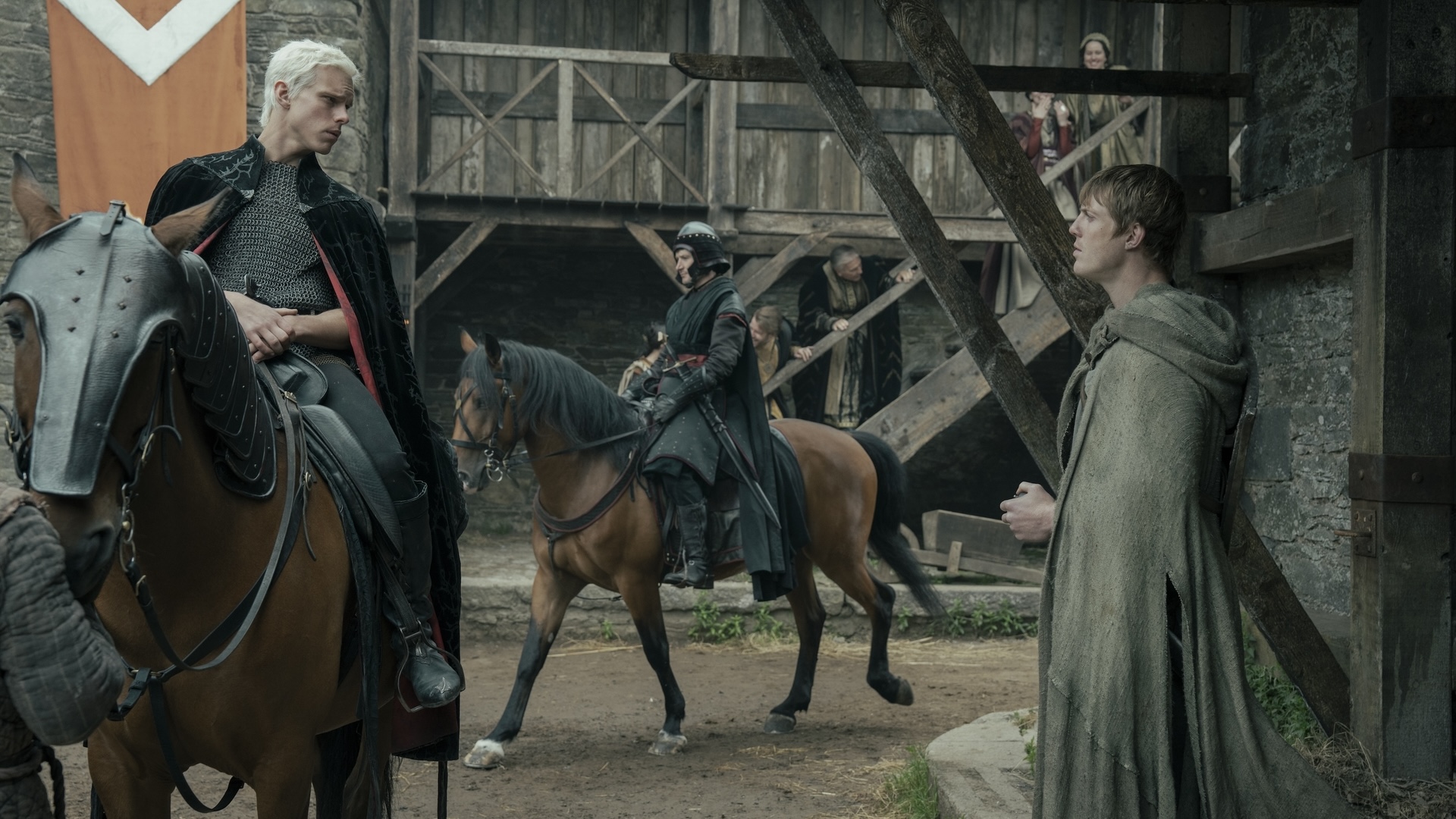
This article contains spoilers for A Knight of the Seven Kingdoms episode 1 “The Hedge Knight.”
When HBO set out to adapt his “Tales of Dunk and Egg” novellas into Game of Thrones prequel series A Knight of the Seven Kingdoms, writer George R.R. Martin had one small request for production.
“I said, ‘Let’s do the best jousting sequences that have been ever put on film,’” Martin revealed at New York Comic Con 2025. “A modest little challenge for [showrunner Ira Parker] and his crew.”
The Hedge Knight, the first Dunk and Egg novella upon which the first season of A Knight of the Seven Kingdoms is based, features its fair share of Medieval-style tournament action. Following the death of his master Ser Arlan of Pennytree, titular hedge knight Ser Duncan the Tall (Peter Claffey) decides to make a name (and some coin) for himself by entering the lists at the Tourney at Ashford Meadow. This gives A Knight of the Seven Kingdoms plenty of opportunities to make good on Martin’s challenge and redefine what a live-action jousting sequence can be.
While few often think of jousting stories as their own subgenre of fiction, a surprising amount of movies and TV shows have been built around the spectacle of armored knights on horseback smashing into other armored knights on horseback. Entries within the jousting canon include 2021’s The Last Duel, 1981’s Excalibur, and 1952’s Ivanhoe (which Martin identifies as the closest to getting the whole thing right). One jousting movie in particular, however, tends to stand out among the pack. And its conceit resembles A Knight of the Seven Kingdoms‘ closely enough that showrunner Ira Parker banned mention of it from the writers’ room and set.
“[A Knight’s Tale] is the only thing that we were not allowed to speak of in the writers room or on set,” Parker says, “It’s a brilliant movie that has an enduring quality, but we came out first. The Hedge Knight was written two years before that came out.”
Parker is right. Despite its frankly unacceptable 59% Rotten Tomatoes score, A Knight’s Tale is a brilliant movie. It’s also strikingly similar to The Hedge Knight and now A Knight of the Seven Kingdoms. In the 2001 film, Heath Ledger stars as William Thatcher, a lowly squire in 14th century Europe who dreams of big things. Destiny comes knocking for Will in the opening scene when the knight he supports, Sir Ector, dies from unseen injuries following a joust, allowing William to don his armor and finish off the tournament. Together with fellow squires Roland (Mark Addy, who would go on to play Game of Thrones‘ King Robert I) and Wat (Alan Tudyk), William crafts the false identity of Sir Ulrich von Lichtenstein and continues to enter into tournaments, gradually improving and becoming something of a Medieval sports celebrity.
This should all sound fairly familiar to those who have now seen A Knight of the Seven Kingdoms‘ first episode (which is fittingly called “The Hedge Knight”). Like A Knight’s Tale, this story opens with the death of a knight and a squire electing to take up his horse, sword, and armor to continue to joust. While Ser Duncan the Tall doesn’t adopt the identity of a fallen knight or fabricate a new one like William Thatcher does, there does seem to be an element of fiction in his assumption of knighthood. He swears that Ser Arlan frequently discussed knighting him before he died, but a flashback reveals that Ser Arlan consented to no such thing. Similarly, the name “Duncan” itself might be a new creation.
“What’s your name?” Ser Duncan’s new squire Egg asks him.
“Dunk.”
“Ser Dunk? That’s no name for a knight? Is it short for Duncan?”
“Yeah…uh, yes… Ser Duncan of… Ser Duncan the Tall.”
To be clear, A Knight’s Tale and A Knight of the Seven Kingdoms‘ comparable beginnings is not a case of one copying the other. The Hedge Knight was first published in 1998, two years after the first Song of Ice and Fire novel A Game of Thrones was released and well before the franchise became a global phenomenon so it was unlikely to influence a Hollywood motion picture. If anything, A Knight’s Tale filmmaker Brian Helgeland was more explicitly inspired by “The Knight’s Tale” chapter of Geoffrey Chaucer’s 14th century classic The Canterbury Tales. Chaucer even appears as a character in the film played by Paul Bettany (which just goes to show you that every Den of Geek article is destined to intersect with Marvel at one point or another).
This is all just a simple case of twin movie kismet – an example of how different storytellers can seize the same concepts simultaneously and independently. Parker sums up the phenomenon with an assist from a literary icon.
“Joan Didion talks about this the best. These ideas float along in the ether. You can pull them down and use them, but if you stop using it, it goes back up and somebody else can grab it down. I don’t know how that works but it seems to work some way. Also, it’s a very classic knight’s tale. Both of these are, which is, I think, a big part of the enjoyment of this. Nobody does these sort of stories better than George.”
New episodes of A Knight of the Seven Kingdoms premiere Sundays at 10 p.m. ET on HBO and HBO Max, culminating with the finale on February 22.
The post A Knight of the Seven Kingdoms: The Movie Not Allowed to Be Discussed on Set appeared first on Den of Geek.