By
By 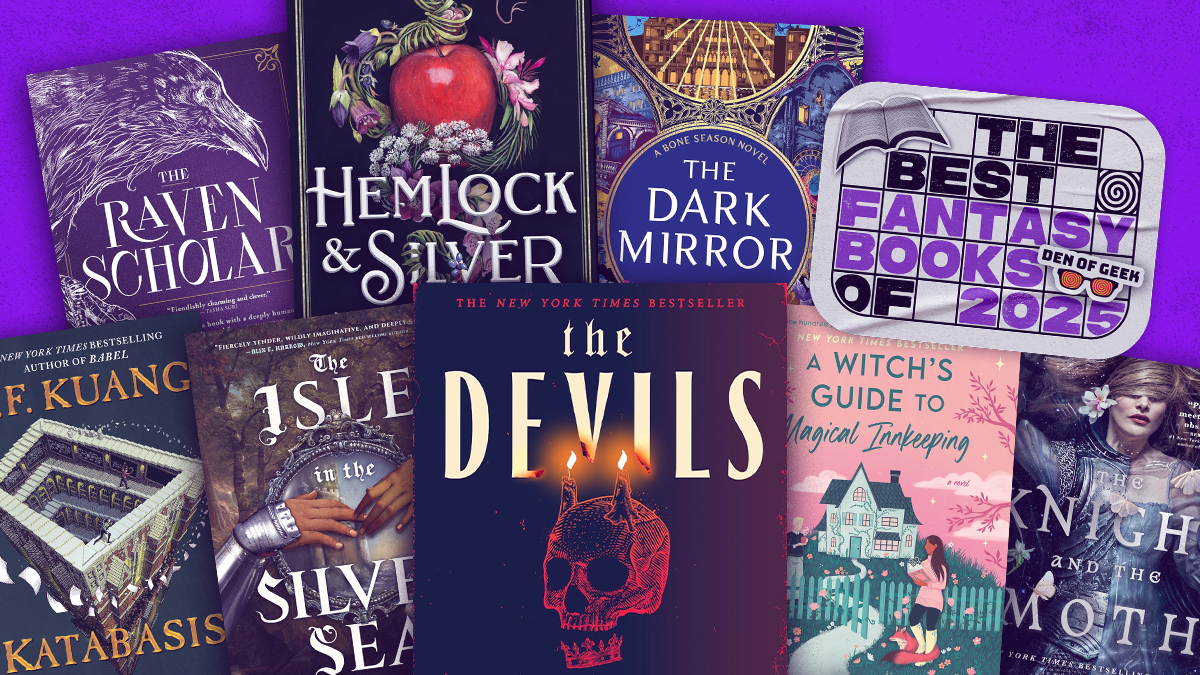
While 2025 failed to meet the customer satisfaction standards of many (most?) of us, at least we can say with confidence: Man, the books were good.
It’s been a year full of outstanding titles across genres, no matter whether you tend to gravitate toward contemporary fiction, horror, mysteries, thrillers, young adult titles, or romance. But fantasy fans in particular were absolutely spoiled for choice in 2025, with established authors and exciting new voices dropping a seemingly endless stream of highly-anticipated sequels, new series openers, and buzzy debuts. It’s been a year full of dragon riders and vampires, along with talking animals, burned-out witches, fated lovers, oddball healers, and magical oracles. (And that’s just the books that made this list.)
Here are 12 of the best fantasy books of 2025.
The Raven Scholar by Antonia Hodgson
The most delightful surprise of the year, historical mystery writer Antonia Hodgson’s epic fantasy debut is the fantasy genre at its absolute, most addictive best. One part murder mystery and one part tournament competition, The Raven Scholar is a 600-plus-page doorstopper with a massive cast of morally complex and richly drawn characters, where every chapter feels not only relevant but utterly necessary.
The story follows titular scholar Neema Kraa, a prickly, socially awkward, and frequently unlikable heroine who finds herself embroiled in a fight for the throne — and the prime suspect at the center of a mysterious death. Hodgson’s sprawling tale delights in upending reader expectations about what kind of story they’re following, wrestling with everything from complex politics to religious history, all while building the sort of fully lived-in universe that exists well beyond the page. It’s an absolute triumph, whose multiple, jaw-dropping twists will leave everyone gagging for the sequel that’s reportedly coming in 2026.
The Dark Mirror by Samantha Shannon
The fifth installment in Samantha Shannon’s sprawling Bone Season series, The Dark Mirror, is simultaneously a road map for resistance, an ode to perseverance, and a bright shining ball of hope in a bleak time. It is both a fantastic next step in the larger story of this fictional universe and a necessary reminder that everyone has a role to play in saving the world — or, at the very least, making it a less overtly dark and frightening place than it is at the present moment.
The story picks up six months from the shocking cliffhanger that closed the series’ fourth book as The Dark Mirror determinedly pivots its story outward, taking dreamwalker Paige Mahoney into the wider (free) world beyond the authoritarian Republic of Scion. As the larger story digs into the global political threats represented by the creeping shadow of the Anchor and the rising threat of authoritarianism, the world of the Bone Season expands in new and intriguing ways, all of which go beyond Paige’s story as Shannon pivots the series toward its endgame. Bonus: The slow-as-molasses burn between Paige and her otherworldly ally-turned-lover Arcturus Mesarthim has never been better or more satisfying.
Holy Terrors by Margaret Owen
The rare final chapter in a YA fantasy trilogy that not only sticks the landing but whose ending elevates the entire series into something greater than the sum of its parts, Margaret Owen’s Holy Terrors is emotional, chaotic, and utterly unhinged in all the best ways. It’s also the perfect ending to the story of morally gray, emotionally challenged heroine Vanja Schmidt, a lushly written exploration of power, forgiveness, and self-acceptance that brings almost every aspect of this story full circle.
The sort of finale that not only acknowledges you having read the earlier books in the series, but relies on it, Holy Terrors is full of familiar faces and emotional beats, literally retracing many of Vanja’s steps as Owen questions what might have been had her heroine made different choices at key crossroads of her life. And its emotional core relies on the deep interiority that has been established across the rest of the series – Vanja’s growth feels earned and the story’s ending so satisfying precisely because we’ve been right beside her through every mistake and step forward she’s made. It’s hard to overstate how evident Owen’s care and craft are throughout this tale or how utterly satisfying its conclusion turns out to be.
Bury Our Bones in the Midnight Soil by V.E. Schwab
At this point, what can’t V.E. Schwab do? She’s written books for almost every kind of audience, penned both standalones and multi-book series, and dabbled in genres that include fantasy, young adult, and literary fiction. Basically, all that most of us needed to be completely sold on her latest novel, Bury Our Bones in the Midnight Soil, was to learn that she wrote it. Luckily, the book itself is fantastic, a story of toxic lesbian vampires that feels like the darker cousin of Schwab’s time-bending blockbuster The Invisible Life of Addie LaRue. But where Addie was a story of memory and immortality, Bury Our Bones is about rage and desire, a tale that’s haunting, heartbreaking, and horrifying by turns.
Told across multiple timelines across 16th-century Spain, 19th-century England, and 21st-century America, Schwab weaves a story of three very different women who share a similar frustration with the lives they’re living. Featuring lush historical details, richly drawn characters, and a slow-burn narrative that deftly explores queer identity, female resilience, and the infuriating ways that women have long been asked to make themselves smaller in order to be accepted by society. Its story often feels like Interview with the Vampire for a new era, but also something refreshingly brand new.
Onyx Storm by Rebecca Yarros
If, for whatever reason, you haven’t dipped your toe into publishing’s megapopular romantasy trend, now’s the time to fix your life. And there’s nowhere better to start than with the Fourth Wing saga — a fantasy romance set at a military college for dragon riders — which helped to launch the sub-genre into the stratosphere this year. (As of early 2025, the three books in the series have sold over 12 million copies to date, and a Prime Video TV adaptation is currently in the works.)
Onyx Storm, the third installment of Rebeca Yarros’ bestselling Empyrean series, is as addictive and propulsive as anyone could ask for, offering fans everything from complex political intrigue, magic, and betrayal to swoon-worthy romance and plenty of spicy sex scenes. (And that’s before you get to all the dragons and their drama.) And its action-packed ending, which featured big twists like a surprise marriage, lost memories, missing dragon eggs, and a hero who may have turned to the dark side, has kept everyone talking since the book hit shelves back in January. Since Yarros has publicly announced she’s taking a bit of a break before continuing the series (she penned the first three books in just under 20 months), the wait for book four seems especially endless. But there’s enough thrills here to power
A Witch’s Guide to Magical Innkeeping by Sangu Mandanna
One of the other big trends in fantasy this year is the cozy read, which, given… well, everything happening in the real world right now, makes a ton of sense. A product of the COVID-19 pandemic, these charming, low-stakes stories tend to focus on relationships, romance, and emotional character beats rather than, say, battles for the future of a kingdom with a hard-to-pronounce name. In lots of ways, they’re like a hug given book form, and they offer peak escapism for readers who want something sunny and fun without all the stress and death that can so frequently feature in epic fantasy titles.
This year saw a lot of great books released in this space, from buzzy sequels like Emily Wilde’s Compendium of Lost Tales by Heather Fawcett to new arrivals like The Enchanted Greenhouse by Sarah Beth Durst and Violet Thistlewaite Is Not a Villain Anymore by Emily Krempholtz. But, no other title represents the absolute best of this particular sub-genre like A Witch’s Guide to Magical Innkeeping, a peak cozy fantasy tale about a witch who lost her powers after resurrecting her great-aunt. Cast aside by the magical communities, she helps said aunt run an enchanted inn in Lancashire, where she must deal with its bevy of quirky guests, manage the escapades of a semi-villainous talking fox, and maybe, just maybe, find a way to get her life (and her power back on track… with some help from a handsome historian, of course.)
Katabasis by R.F. Kuang
Katabasis is not a fantasy story for the faint of heart. A dense, fantastical, deeply academic tome about a pair of rival PhD students who must descend into Hell, Dante Alighieri-style, in an attempt to locate a recently deceased advisor, it’s a novel that wrestles with philosophical concepts and literary theory as much as it does with individual character traits or the specific rules of the complicated magical system at work in its world. A story that makes academia into a literal hellscape — which, those who’ve ever been part of it can tell you, really does kind of track — Katabasis mixes institutional satire, dark humor, fascinating world building, and thorny moral questions about purpose and progress.
Like Kuang’s previous doorstopper fantasy, Babel, Katabasis has its share of flaws, which those who are regular readers of the author’s work are probably already well aware of. (There’a certain level of preachiness, a resistance to trusting her audience to make big thematic connections without having the ideas spelled out for them, and character development definitely comes second to exploring larger intersections of various literary theories, works, and authors.) But — and again, much like Babel — this book is also precisely the kind of story the fantasy genre needs more of: Big, audacious, ambitious swings that remind us that this is a genre that’s capable of pushing boundaries in a way that most people only ever give literary fiction credit for.
The Knight and the Moth by Rachel Gillig
Many fantasy fans have likely heard of author Rachel Gillig thanks to her (excellent) Shepherd King duology blowing up on BookTok, but her latest release, the Gothic-tinged fantasy The Knight and the Moth, is even better. Set in a medieval-esque world where magic is real, gargoyles are sentient, and isolated villages are connected almost solely through the power of belief in their six gods known as the Omens. It follows the story of one of the six mystical diviners at Aisling Cathedral, who are all repeatedly drowned to bring forth mystical visions that foretell the future. But when the Diviners begin to go missing one by one, it’s up to Six — who has sacrificed her name and her identity in service to the cathedral — to find them, with the help of a nonbeliever knight named Rodrick.
A lyrically written exploration of faith, self-discovery, and the power of storytelling, The Knight and the Moth is romantic in almost every sense of the word, from its atmospheric worldbuilding and lush imagery to the slow burn relationship that develops between the story’s protagonists. As Six starches for her missing sisters, she’s forced to confront not only her preconceived notions about who she is and the work she’s spent her life devoted to doing, but also the very idea of belief itself and how the stories we choose to tell about the things we believe can literally shape the world.
The Devils by Joe Abercrombie
A delightfully old-school fantasy epic that feels like a throwback in all the best ways, Joe Abercrombie’s The Devils is for the readers who haven’t wanted to dive into any of the genre’s popular sub-tiers this year. A good old-fashioned adventure romp that follows a team of misfit criminals assigned to escort a street thief turned long-lost princess back to the kingdom she’s never known, the story is bonkers from start to finish, full of political maneuvering, team infighting, betrayals, and surprise twists. But it’s the relationships between and among the characters that will catch and keep your attention throughout the story
The titular Devils — technically known as the servants of the Church of the Holy Expediency — are all working off the various ecclesiastical convictions handed down to them from Her Holiness Pope Benedicta, who believes that even the worst evil can be repurposed in the service of good. Her theory is certainly tested with this group, which includes (but is not limited to) a cursed knight who cannot die, a Scandinavian werewolf, a vampire, and a necromancer. Though their quest faces many challenges throughout the book’s 500-some pages, it stays completely unhinged (complimentary) and hilariously unpredictable from start to finish.
Shield of Sparrows by Devney Perry
Lots of big-name authors took the plunge into new genres this year, and it shouldn’t surprise anyone that romantasy was one of the most popular subgenres when it comes to new debuts. Shield of Sparrows marks bestselling romance author Devney Perry’s first foray into the world of fantasy, and it’s an action-packed, swoony enemies-to-lovers ride.
The story follows a princess whose predictably dull world is turned upside down when she’s pledged in a treaty marriage to a rival kingdom in place of the younger sister who’d been preparing all her life for the job. As she journeys to her new home in the monster-infested kingdom of Turah, Odessa must not only endure a crash course in politics, spy for her father without getting caught, navigate an arranged marriage to a husband who barely speaks to her, and deal with his ever-present, constantly lurking magical bodyguard known simply as the Guardian. A refreshingly average heroine who tries her best, a delightfully banter-y slow burn romance, and a fast-paced, twisty plot help Shield of Sparrows stand out in the year’s crowded romantasy pack.
The Isle in the Silver Sea by Tasha Suri
If you read Tasha Suri’s (fantastic) Burning Kingdoms trilogy, you already know she’s an author skilled at building lavish fictional worlds and compelling queer romances. But she truly outdoes herself with The Isle in the Silver Sea, a fairytale-tinged fantasy set in an alternate version of the British Isles that is literally fueled by the power of stories, as human avatars of various fictional archetypes are forced to live out their fated destinies across multiple lifetimes.
Simran and Vina are the latest incarnations of the Knight and the Witch, a pair of doomed lovers destined to enchant, betray, and die for one another over and over again. Their story is fated to end with the Knight slaying the Witch and themselves, but this time, they’re determined to break the cycle and find a happy ending. Meanwhile, a mysterious assassin begins methodically killing other incarnates and threatening the very future of the Isle itself. Steeped in medieval folklore and snippets from familiar fairytales, Suri’s ambitious tale is not only a compelling, tragic romance in its own right, but an interesting meditation on storytelling itself, particularly concerning ideas of propaganda, power, and who gets to control the shape of their own narrative. A rare fantasy standalone that probably should have been a duology, it’s a rich and immersive read.
Hemlock & Silver by T. Kingfisher
T. Kingfisher (the adult pen name of the children’s author Ursula Vernon) is one of the best fantasy writers that far too few people have heard of. (Consider this an exhortation to fix your life, is what I’m saying.) A writer with a unique gift for using classic tropes and themes from fairytales and folklore to subvert and expand the idea of what fantasy can be and do, her books mix humor, heart, and an occasional dash of horror to create something that feels both timeless and somehow brand new.
Such is the case with her latest novel, Hemlock & Silver, a unique spin on the story of Snow White that transfers the story to an arid New Mexico-esque kingdom of deserts and snakes to follow the story of an oddball healer named Anja and her feline sidekick who are charged with solving the mystery of Princess Snow’s strange illness, which everyone presumes to be poison. Anja makes for a fantastic offbeat heroine, a middle-aged, socially anxious, plus-sized, analytical type, precisely the sort we almost never see in stories like this. The shift to a diagnostic medical mystery makes for a refreshingly novel approach to a tale we’ve heard a million times before, and, as is usually for a Kingfisher joint, the supporting characters are top-notch. Weird, surprisingly creepy in places, and altogether wonderful.
The post The Best Fantasy Books of 2025 appeared first on Den of Geek.