By
By 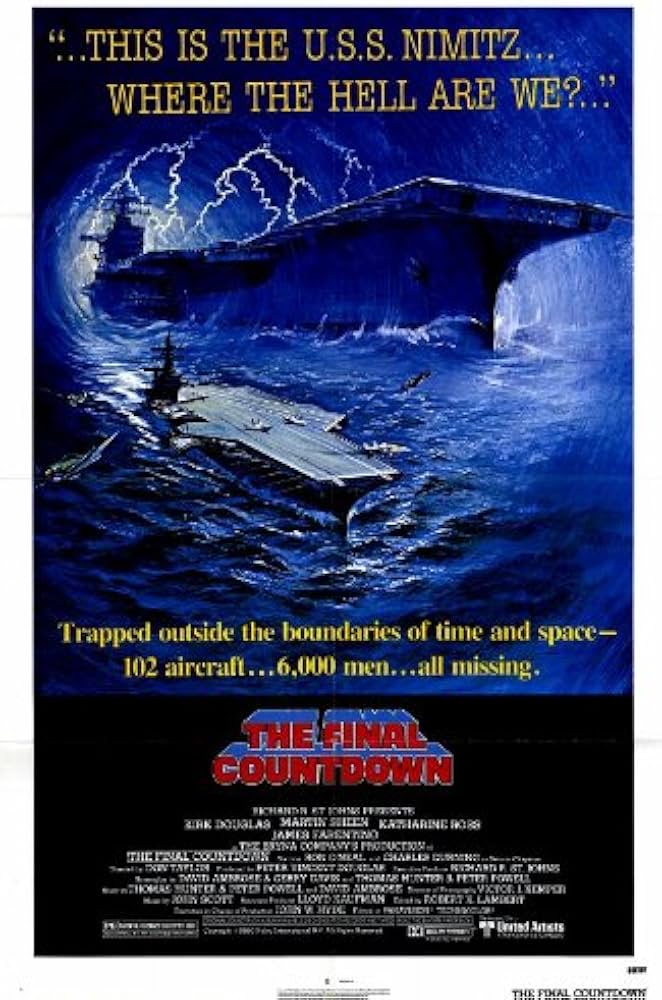
The 80s were so awesome that the decade could do Top Gun and Pearl Harbor, in one movie, many years before either movie actually existed. How? Timey-wimey stuff! Probably best if you don’t think too hard about all this and just trust us. It’s one of the great unhinged cinema artifacts of the early 1980s. It is equal parts military recruiting ad, dad-fantasy, and science-fiction head-scratcher. Buckle up, because we’re sailing through time and faulty logic aboard the USS Nimitz in The Final Countdown.
The Final Countdown
The Final Countdown is that rare breed of movie that makes you ask: “Why is this on the big screen?” and “Hell yes, I want more of this!” in roughly the same breath. It’s an aircraft-carrier movie crossed with a time-travel yarn crossed with a US military power fantasy so unabashed that it could make Top Gun blush, and predate it by six years.
Picture it: a massive American nuclear carrier, the USS Nimitz, cruising the Pacific in 1980, F-14 Tomcats ready to rock and roll, when suddenly… POOF… out of nowhere and with absolutely zero in the way of explanation, there is a time vortex.
Next thing you know, it’s December 6, 1941, and the mighty Nimitz is parked off Pearl Harbor like some anachronistic Uber of Death, ready to intercept the Japanese fleet with 1980s naval superiority. It is simultaneously the coolest and dumbest thing ever put on celluloid.
Enter Kirk Douglas, Captain America. Capt. Matthew Yelland is a stern skipper with a chin that could probably steer the Nimitz on its own. Douglas is late-career hot sauce here. Gravelly, commanding, and clearly relishing the chance to bark orders like a WWII drill instructor who just discovered the French invented espresso. His presence alone sells absolutely any scene he’s in, even if the script is asking him to debate butterfly effect theory like a college freshman who just discovered The Hitchhiker’s Guide to the Galaxy.
Douglas’ son Peter Douglas produced the film, and it’s documented that Dad had to be convinced he was right for the role, lest it smell of nepotism. But once you see him swagger around that carrier’s bridge, you forget any doubt existed. He owns this movie like a man in the Pacific Northwest owns an umbrella.
He is joined by Martin Sheen, who may be a civilian observer or also some kind of unwitting Time Lord. His Warren Lasky is a civilian systems analyst whose main job in life appears to be politely reminding the Navy that he exists. Sheen, fresh off Apocalypse Now, plays Lasky with a subdued bewilderment that’s oddly perfect: he’s the audience surrogate, watching this royal cluster of paradoxes unfold with that classic Sheen “I did not sign up for this, but also this is awesome” energy.
Here’s the thing about Lasky: the movie never quite tells you why he’s on board.
You get some vague defense-contractor mumbo-jumbo. You end up feeling like he’s possibly a time-travel implant sent by future historians to keep things vaguely grounded, or at least to ask all the plot-logical questions no one else bothered to answer. Why is he there? Who hired him? Does he get frequent flyer miles from this? We may never know. Maybe there is a novelization that goes deeper?
The second star of this movie is really the F-14. The Nimitz is technically the lead star. In 1980, the Tomcat was basically the new hotness of naval aviation, the stallion of the carrier deck, with variable-sweep wings and missiles that go boom. Getting two of them from VF-84 Jolly Rogers onscreen scrapping with repurposed WWII Zeros (actually AT-6 Texans wearing red paint) is simultaneously exhilarating and ludicrous.
You want modern jets versus 1940’s props? You got it. You want dogfights over how weird time travel is? You sort of get it. You want them to actually blow the absolutely crap out of the Japanese fleet and then carve the Nimitz’s name into history? Don’t be silly. That is just too far and therefore renders this movie basically cinematic blue balls.
The Plot: Ethics or Excuse?
So here’s the central question the movie pretends to wrestle with: Now that a fully armed nuclear carrier is parked where it could literally rewrite history, do you stop the attack on Pearl Harbor and prevent a massive tragedy, or do you spare reality the headache and let history rumble on as it did? It’s a neat moral riddle in theory. The execution is… well, let’s say you could’ve scribbled half the logic on a napkin between scenes of trims and takeoffs.
You have side characters like Charles Durning as Senator Chapman and Katharine Ross as an aide with her dog Charlie stumbling through this temporal clusterfuck with all the sense of someone who just got handed a script and told, “Remember, you’re ‘important’.” And James Farentino is also there, pre-taking control of Blue Thunder for television, as the CAG who is helpfully a history nut and who probably understood more of the plot than half the audience.
The ending! Oh lord, the ending. Just as you’re picturing F-14s screaming across the golden Pacific skies, Jap carriers smouldering as they slip beneath the waves before breakfast, and Admiral Yelland giving a “Hell yeah USA” speech… POOF… another completely unexplained vortex yawns open and we’re back in 1980.
No explosive battle. No alternate history. No nothing. Just the Nimitz slipping back into time like a teenager sneaking home late after curfew. And then, in a cutesy twist, someone who was left behind ages forty years and shows up at the dock just to reveal the complexity of their paradoxical existence.
It feels like the screenwriters said:
“We have one movie’s worth of story, but can we make it feel like three quarter-finished novellas smashed together?”
But damn, if the end doesn’t re-ignite your affection for the damn thing.
The Final Countdown was produced with full U.S. Navy cooperation, and it shows. You’re basically watching a Navy recruitment film with time travel sprinkled over the top like glitter in a war room. They shot aboard the real USS Nimitz with actual sailors as extras, making the deck scenes irresistibly authentic. Even naval operations look tighter than 1980s jeans.
It wasn’t a smash hit like Star Wars, but it was no flop either. Made on a budget of roughly $12.5 million, it grossed around $56.6 million worldwide, with a respectable, if not breathtaking, turnout in theaters.
It had to swim against the 1980 tide in a summer that was littered with cultural behemoths, leaving The Final Countdown feel like a smaller, oddball cousin trying to get into the same family photo.
Then came VHS, and The Final Countdown found its home. Its moment had arrived!
Like every sci-fi/military geek’s video store staple, it thrived in the rental market throughout the early ’80s. Teens and grown-ups alike grabbed that box art, often with F-14s in full zoom, and raced home on Friday nights to watch Nimitz’s weird temporal misadventures on their VHS players. Anecdotally, it became one of those titles that everyone rented multiple times because cable TV placements only fanned the cult flame.
And here is the rub. For all its silliness and total lack of anything approaching logic, or any explanation at the heart of whatever the hell is going on, The Final Countdown is awesome… in that late-night, beer-in-hand, “did that just happen?” kind of way.
It’s goofy, it’s heartfelt, it’s spectacularly unhinged, and it genuinely loves every glorious second it spends showing Tomcats launching off a carrier deck. It taps into that goofy American power fantasy – “What if we showed up with 1980 tech in 1941?” – and just relishes the spectacle of it all.
Yes, it’s a cinematic military wish-fulfillment fantasy with plot holes big enough to park a Tomcat in. Yes, the logic leaps are nearly constant. Yes, the ending leaves you shouting at the screen:
“Just show the dogfight! Let them blow up the fleet!”
But holy hell if it doesn’t stick in your brain like one of those public safety infomercials that showed kids dying in horrible ways.
If you love retro sci-fi mixed with naval hardware and the sheer spectacle of an absurd premise executed with earnest enthusiasm, The Final Countdown is your guilty pleasure and your late-night classic.
The post Retro Review: THE FINAL COUNTDOWN (1980) appeared first on Last Movie Outpost.