By
By 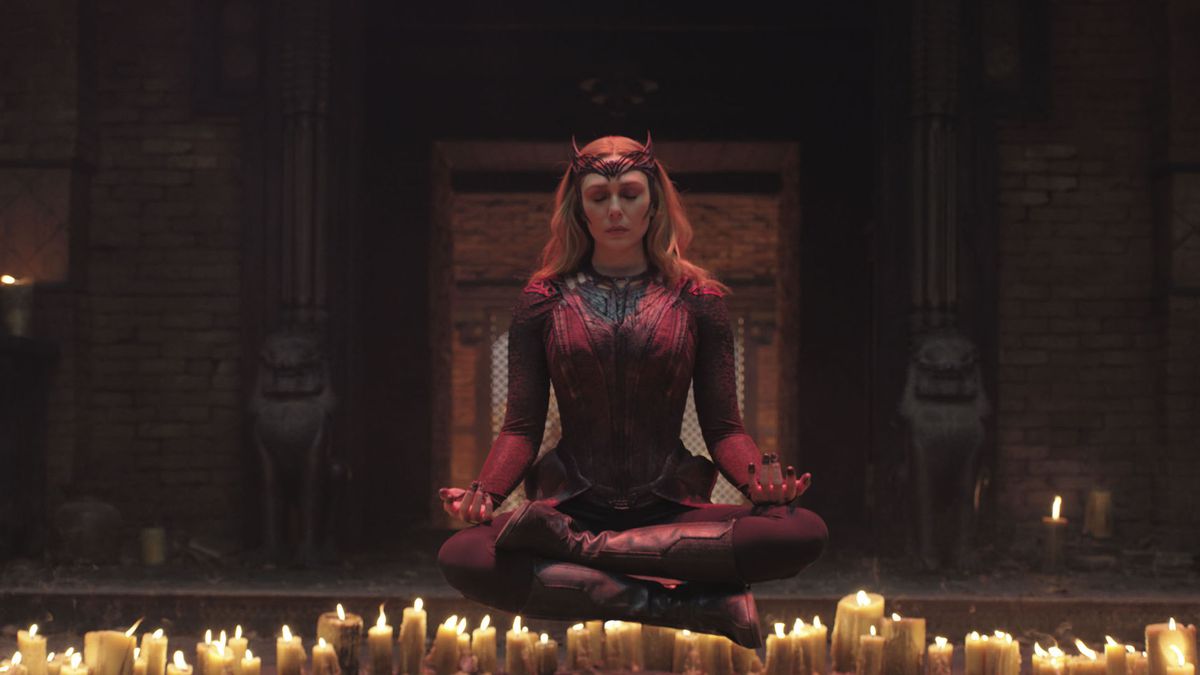
Wanda Maximoff may be the villain of Doctor Strange in the Multiverse of Madness, but that doesn’t mean she’s not right. Early in the film, when Stephen Strange charges Wanda with being reckless with her magical abilities, she points out that she gave Thanos the Time Stone, the one thing the Sorcerer Supreme must defend. “You break the rules and become a hero. I do it and I become the enemy,” she sneers. “That doesn’t seem fair.”
Wanda is right. Male heroes are lauded for gaining great power and doing things their own way, whether it’s Tony Stark disregarding the U.S. government or Star-Lord violating galactic treaties. But when women get power, they immediately go mad, proving not only that they cannot be trusted with great abilities, but also that they are fundamentally weaker than their male counterparts. It’s a problem that goes deeper than Multiverse of Madness, before the MCU, all the way to the heart of Marvel Comics.
Girl Power?
Women have always been part of the Marvel comics universe, which counted Sue Storm of the Fantastic Four as one of its first characters before adding founding X-Man Jean Grey and founding Avenger Wasp not too long afterwards.
Admirable as this inclusion may be, few would find much to cheer about in these early Marvel stories. Not only did the characters’ codenames diminish them—Sue was Invisible Girl until long after she had become a wife and mother, and Jean was (and often is again) Marvel Girl—but the dialogue that Stan Lee wrote over the pencils of Jack Kirby and other artists was often frankly insulting. Sue, in particular, would trip over nothing in the middle of battle, get easily captured by bad guys, or go off to sulk.
Later writers gave Marvel’s female characters more to do, but unpleasant tropes persisted. In 1970’s Avengers #83, a team called the Lady Liberators—consisting of Valkyrie, Medusa of the Inhumans, Black Widow, and Scarlet Witch—resist male oppression by taking over Avengers Mansion. Even though Wasp defeats the Liberators and even though they’re revealed to be mind-controlled by Thor villain the Enchantress, the issue trades in a lot of unpleasant stereotypes.
The most infamous example of Marvel misogyny may be Avengers #200, penciled by George Pérez and credited to four writers: then Marvel Editor in Chief Jim Shooter, Pérez, Bob Layton, and David Michelinie. The story involves Carol Danvers, then called Ms. Marvel, suddenly becoming pregnant with the child of a Kang the Conquerer variant called Marcus Immortus. The child ages rapidly to adulthood and reveals his identity, which, for some reason, convinces Carol to go into space with him.
Carol’s story was later called out and retconned in the fantastic Avengers Annual #10, and even Shooter, a man not famous for his apologies, admitted that it shouldn’t have made it to print. But that doesn’t take away the fact that the Marcus Immortus story, like many of the crazy women tales, has become one of the characters’ defining moments. And when a character gets adapted into other media, such as the MCU, those stories often travel with them.
A History of Hysteria
Jean Grey died a hero. Even though the Dark Phoenix Saga has been adapted into two movies, X-Men: The Last Stand and Dark Phoenix, that fact may come as a surprise. But it’s a crucial point that’s important for understanding what writer Chris Claremont and artist John Byrne were trying to do in Uncanny X-Men #129–138 (1980).
The story begins with Jean Grey pushing her telekenetic powers further than ever before to save the X-Men from dying in a crashing shuttle. The event draws the attention of a galactic force of nature called the Phoenix, who nestles inside of her and gives her even more abilities. Shortly thereafter, the psychic villain Mastermind undergoes a long campaign of manipulation, which eventually unleashes Jean’s new abilities and changes her into the Dark Phoenix.
When the Dark Phoenix destroys a planet full of people who look like broccoli for some reason, she’s held for trial by the Shi’ar Empire. When the trial and the Phoenix threaten to destroy the X-Men, Jean decides to sacrifice herself to save her beloved friends.
From Claremont’s perspective, the Dark Phoenix Saga was about Jean Grey facing down an incredible cosmic threat and eventually overcoming it, even if she lost her life. But to most people adapting the story, the Dark Phoenix Saga is about a woman who received great power and was overcome by it.
Sadly, that latter reading is more true of other stories by the saga’s co-creator, John Byrne. In the pages of West Coast Avengers, Byrne told how Wanda Maximoff a.k.a. the Scarlet Witch, still troubled by the loss of her husband Vision of their children Tommy and Billy, is manipulated by her father Magneto into turning against her teammates. Although a man is at the root of her heel turn, the implication is that Wanda is too weak, too susceptible to manipulation to handle her vast magical abilities. Years later, writer Brian Michael Bendis would double-down on that point, when Wanda suffers another breakdown and uses her reality-warping abilities to first destroy the Avengers and later to wipe out most of the mutants.
The list goes on: Sue Storm getting possessed by Malice, She-Hulk experiencing bursts of rage like her cousin Bruce, Rogue having too many voices in her head, and so on. Most major female characters in the Marvel Universe have gone mad with power at some point. And, in many cases, that becomes their defining story.
These stories stick in readers’ imaginations for obvious reasons. They have incredible stakes, and watching someone turn from good to evil always creates interesting drama. But when they become the defining stories of female characters, these stories begin to reinforce a trope, suggesting that we all are threatened when women gain power.
More Women, More Stories
At this point, one might lodge a counter-argument. Isn’t it a good thing that the MCU adapts the comics? Isn’t that we love about seeing the Avengers get together or watching deep cuts like Shang-Chi and the Guardians of the Galaxy on screen?
Others may point out that male characters often go mad too. Marvel has given us Steve Rogers as a Nazi, Tony Stark as a secret agent of Kang, and Professor X doing all manner of shady stuff. How come we’re not worried about those?
The answer to the first charge is obviously “Yes.” But the MCU has never slavishly adapted the source material without making changes. Even when it copies direct moments from the comics, such as Captain America punching Hitler or the dead gods in Thor: Love and Thunder, the franchise re-contextualizes things for a new story or to update out-of-date social norms. Certainly, they can do the same, finding new ways to tell the Dark Phoenix Saga, Wanda’s madness, or other touchstone tales in a manner that gives the women agency.
The second charge brings up an even better solution to the problem of Marvel’s crazy women. The reason we don’t fret too much about the time Cap said “Hail Hydra” or Tony Stark served Kang is because they aren’t the defining stories involving those characters. Steve, Tony, Charles Xavier, and nearly every other male Marvel hero gets to have a whole range of experiences. So, sure, Peter Parker always goes a little nuts when he wears his black symbiote suit, but we forgive him because we’ve seen him do so many other things.
So if we want to keep stories about Jean losing her mind from the Phoenix or Wanda’s brain breaking when her dad starts messing with her, that’s fine—as long as they get a lot of other stories too, showing how they, like every other human being, has a variety of moods and mindsets.
Only then will crazy powerful arcs just be one more moment in the life of a superhero. Only then will it be fair.
The post The MCU Needs to Ditch the Crazy, Powerful Woman Trope appeared first on Den of Geek.