By
By 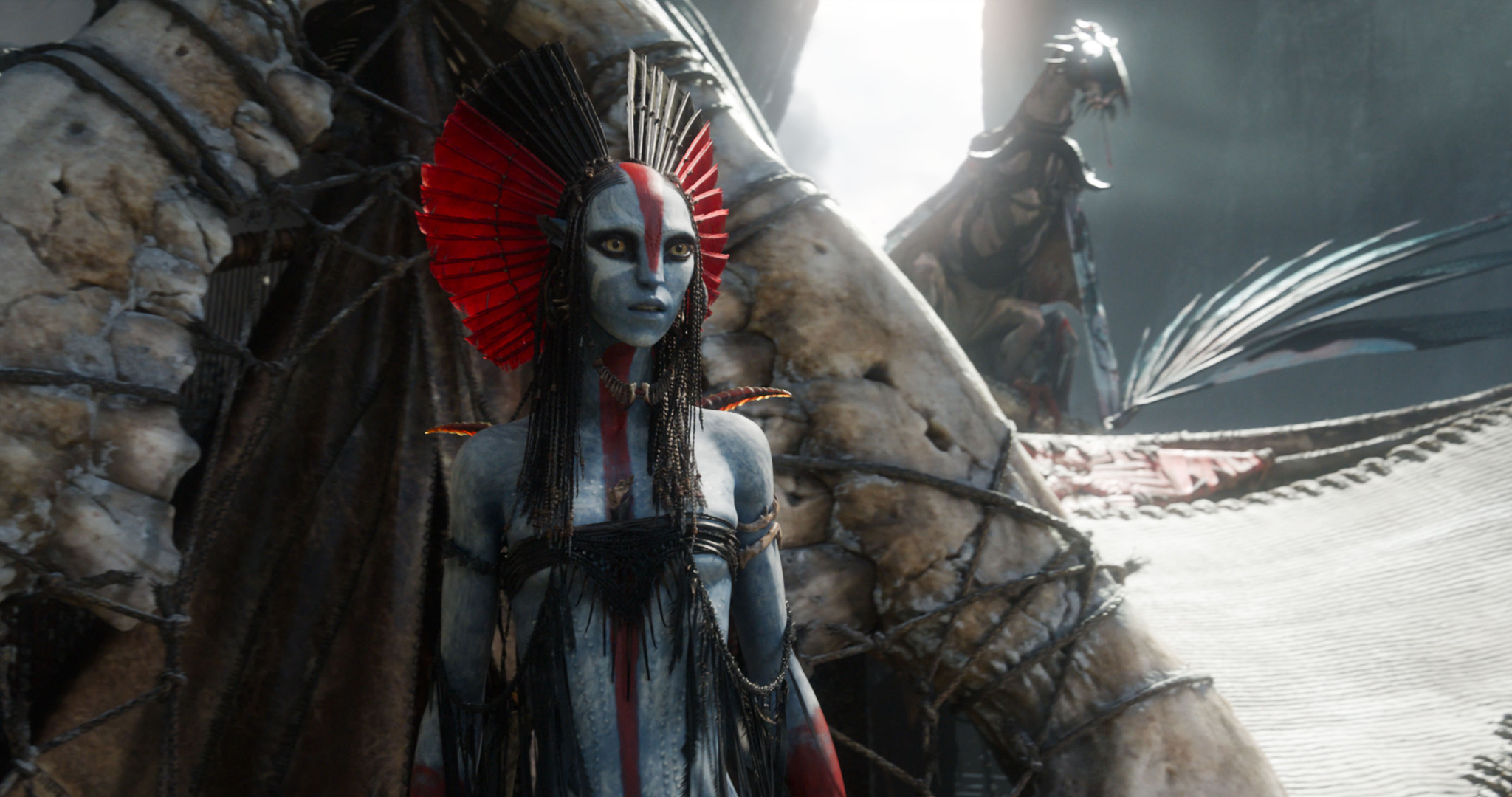
Avatar: Fire and Ash (2025)
The world of Pandora will change forever.
After the mixed but undeniably ambitious Avatar: The Way of Water (2022), James Cameron returns with Avatar: Fire and Ash, a sequel that feels more confident, more focused, and — crucially — more alive. Where its predecessor often leaned heavily on technical achievement and expansive world-building, this third chapter sharpens its narrative priorities, grounding its spectacle in clearer character dynamics and more deliberate thematic intent. Cameron doesn’t attempt to reinvent the alien world of Pandora, but he does reshape it, expanding the mythology in ways that challenge previously accepted ideas about the Na’vi and the nature of the conflict itself.
Jake and Neytiri, silently judging humanity — again.
Set after the events of The Way of Water, Avatar: Fire and Ash once again centres on Jake Sully (Sam Worthington) and Neytiri (Zoe Saldaña), who are still grappling with the loss of their son Neteyam as humanity continues to deepen its industrial and military presence on Pandora. Colonel Miles Quaritch (Stephen Lang), still an Avatar recombinant, remains a looming threat, driving renewed human operations as the fragile balance between clans begins to fracture. As tensions escalate, the Sully family is forced back into open conflict, navigating a struggle that feels harsher and more ideologically divided than before.
The film’s most significant expansion comes with the introduction of the Ash People, or Mangkwan clan — a volcanic, fire-dwelling Na’vi society led by Varang (Oona Chaplin), whose worldview stands in stark contrast to the spiritual harmony of the forest and reef clans. Varang’s evolving dynamic with Quaritch becomes one of the film’s most compelling threads, not only deepening the central conflict but actively challenging the franchise’s long-standing moral framework. Through the Ash People, writer-director James Cameron pushes familiar Avatar themes — colonialism, environmental exploitation, family, and cultural survival — into darker, more confrontational territory, rejecting the idea that the Na’vi are a unified or inherently virtuous people. Rather than repeating a simple noble-indigenous-versus-evil-outsiders dynamic, Fire and Ash suggests that power, resentment, and extremism can take root anywhere when survival is at stake, an idea Cameron presents with his trademark bluntness and clarity.
Terrifying? Yes. Intimidating? Absolutely. Distracting for other reasons? Also yes.
Visually, Fire and Ash is stunning, as expected. Pandora remains one of the most fully realized blockbuster worlds in recent memory, with its seas, forests, and volcanic regions rendered in extraordinary detail. The scale, color, and sense of immersion are consistently impressive, reaffirming Cameron’s unmatched command of large-format spectacle. That said, the film’s high frame rate and 3D presentation — particularly in IMAX — take some adjustment. In the early scenes, the ultra-smooth motion can feel distracting, at times resembling high-end AI-generated video rather than traditional cinematic imagery. While this effect does settle as the film progresses, it remains a stylistic choice that won’t work for everyone.
When Cameron fully leans into action, he reminds us why he remains one of the genre’s defining filmmakers. Fire and Ash delivers some of the franchise’s most inventive large-scale set pieces, particularly those centred on Pandora’s stranger, more hostile lifeforms. Encounters with the Tsyong — striking squid-like creatures — are a highlight, as are the film’s aerial sequences with the dragon-like Ikran, staged with immense scale, visual clarity, and a propulsive sense of momentum.
Neytiri hits the mark — every time.
A rescue mission at Hell’s Gate — the industrial RDA facility seen in earlier Avatar films — stands out as one of the film’s strongest stretches. The sequence balances tension, spectacle, and character beats, with a brief bit involving Jemaine Clement’s Dr. Ian Garvin providing a welcome flash of humor without undermining the stakes. It’s here that Fire and Ash most strongly recalls Cameron at his peak, evoking the controlled chaos of Aliens (1986) and the muscular confidence of True Lies (1994) at once. The action is cleanly shot, easy to follow, and never feels weightless, even at its most effects-heavy.
The final act, while undeniably impressive, does feel rather familiar. Its large-scale confrontation echoes the aquatic climax of The Way of Water, both in structure and visual rhythm. The focus of the battle is once again the Tulkun — intelligent ocean behemoths introduced in the previous chapter — but their portrayal as talking whales adorned with piercings and markings remains hard to swallow. The result is a finale that delivers spectacle in abundance, even if it lacks the freshness that sets it apart from the film’s earlier sequences.
It’s genuinely great to refocus on Sam Worthington’s Jake Sully and Zoe Saldaña’s Neytiri, who remain the emotional backbone of the franchise. Both performances feel more assured here, benefiting from the long-form storytelling Cameron has committed to across the series. Jake continues to grapple with leadership and responsibility in an increasingly fractured world, now shaped by the loss of their son, while Neytiri’s fierce protectiveness and raw grief add an extra layer of emotional intensity, grounding the spectacle in something more personal.
Resurrection comes with complications.
However, the real standout is Oona Chaplin as Varang, the fierce and enigmatic leader of the Mangkwan clan. Her presence is magnetic, combining authority, menace, and an undeniable allure, and her evolving relationship with Stephen Lang’s Miles Quaritch is easily the film’s most compelling element — part ideological clash, part uneasy alliance. Lang once again brings surprising depth to Quaritch, further complicating his role within the story. Elsewhere, Sigourney Weaver’s Kiri remains a quietly intriguing figure, while Britain Dalton’s Lo’ak — Jake and Neytiri’s son — continues his progression toward maturity and self-definition. Jack Champion’s Spider is given a stronger arc as a human increasingly bound to Pandora, including a significant development in which Kiri alters his biology, allowing him to breathe the planet’s atmosphere without a mask. The revelation carries broader implications for humanity’s ability to adapt, while also making Spider a point of interest for the film’s human antagonists. Kate Winslet’s Ronal, pregnant and thrust back into the conflict, brings added emotional weight to the action, her storyline underscoring the real cost of the escalating war.
Running quietly beneath the spectacle is a continued focus on fathers and sons, a theme Cameron has been threading through the franchise with increasing intent. Jake’s leadership is now shaped by grief following the loss of Neteyam, and his relationship with Lo’ak reflects a father torn between preparing his son for a violent world and desperately trying to shield him from it. This dynamic is deliberately mirrored through Quaritch and Spider, whose uneasy bond complicates the film’s moral landscape even further. In both cases, Fire and Ash asks whether sons are destined to inherit their fathers’ conflicts, or whether they can choose a different path — a question that gives the film some of its most resonant emotional weight.
Despite Cameron stating that most narrative threads are already mapped out, Fire and Ash ends somewhat abruptly, even after a hefty 195-minute runtime, with several storylines left unresolved. It doesn’t feel unfinished, but it does feel like the film hits the brakes just as it’s gaining momentum — clearly positioning the next chapter rather than fully closing this one.
Even so, Avatar: Fire and Ash is a clear step up from The Way of Water and a welcome return to form for James Cameron. It’s more confident, more thematically ambitious, and more willing to challenge the moral simplicity of its predecessors. While not without familiar beats and stylistic quirks, it reinforces why Pandora remains one of modern cinema’s most immersive and fully realized worlds. It’s a reminder that when Cameron is fully engaged, blockbuster filmmaking still operates on his terms.
4 / 5 – Recommended
Reviewed by Dan Cachia (Mr. Movie)
Avatar: Fire and Ash is released through 20th Century Fox Australia