By
By 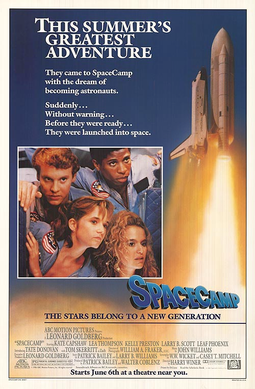
Sorry, I got accidentally waylaid into some 1990s awfulness with Cool As Ice, but I have wandered back into the sheer awesome that was the 1980s again, and all is right with the world. Why? Because this was the 1980s, a decade when NASA could accidentally launch some kinds into orbit and come out of it looking good! Outposters, it’s time for SpaceCamp.
SpaceCamp Summer School
There are movies that feel timeless, and then there are movies that are so aggressively welded to their decade, in this case the 1980s, that they practically arrive wearing leg warmers and asking if you’ve heard this hot new band called Huey Lewis & the News.
SpaceCamp is in this second bracket, and it doesn’t even care.
SpaceCamp is not merely an ’80s movie. It is yet another sacred artifact from the altar of Reagan-era optimism, a film so soaked in earnest hope and blind faith in American technological superiority that it could only have been made in the 1980s, and even then, only briefly before reality stepped in and reminded everyone that rockets are not toys.
This is a movie about a group of children who accidentally get launched into space aboard the space shuttle.
Read that sentence again. Slowly. Let it sink in.
That this premise ever made it past a pitch meeting tells you everything you need to know about the decade that gave us this thing.
And yet, somehow… it works. Not logically. Not scientifically. But emotionally. SpaceCamp is powered entirely by sincerity, and that sincerity is its rocket fuel.
The setup here is simple. Pretentious kids go to what is basically a summer school.
Kids outside of the USA always found this aspect of American culture curiously weird, as it was presented in movies.
The school summer holidays stretch before you like an unfurling landscape of limitless opportunities for freedom and adventure, and these star-spangled dipsticks choose to fill it with more school, or some bullshit “camp”?
The rest of the world should be thankful, as without these quirks, an entire genre of slasher movies would not exist.
Here, the subject is Space Camp, a real place in Huntsville, Alabama, where children voluntarily spend their summer learning math, physics, and how to pretend they are astronauts.
In real life, Space Camp is an educational experience designed to inspire STEM careers. In SpaceCamp, it is portrayed as a place where smug overachievers gather to out-nerd each other while wearing NASA jumpsuits and acting like they’re already on the cover of Time magazine.
These kids are all various flavors of insufferable in their first introductions.
There’s Joaquin Phoenix, still credited as Leaf Phoenix back then, who plays Max, a brooding child genius who resents authority and probably listens to Joy Division when no one is looking.
There’s Tate Donovan as Kevin, the cocky rich kid who thinks the laws of physics apply to other people. There’s Kelly Preston as Tish, the quiet, sensitive one whose job is to be emotionally wounded.
Then there’s Larry B. Scott as Rudy, the comic relief, because every 1980s teen movie was legally required to feature Larry B. Scott. Also, because this is the 80s, every movie needed a go-to black guy who exists to say funny things and react with wide-eyed amazement to the white man’s magic.
These kids chose to be here. They volunteered. There is no archery and fingering somebody behind the mess hall. There are lecturers and simulators.
Goddamn, remember the 1980s when we could do this stuff, before we got all embarrassed about it, and then the Chinese started doing it better and bigger?
Enter Lea Thompson as Kathryn Fairly, perky Space Camp devotee who dreams of being the first female shuttle commander. Lea Thompson was in everything in the mid-’80s. If you turned on a movie between 1982 and 1987, there was a solid chance she would appear on screen.
Adult-wise, they are overseen by Kate Capshaw. She is Steven Spielberg’s wife, straight from Indiana Jones And The Temple Of Doom. Capshaw plays Andie Bergstrom, a camp instructor and future astronaut whose job is to shout exposition while looking concerned. She does this very well.
Alongside here is Tom Skerritt as Commander Zachary Bergstrom, an astronaut who has seen some things. Skerritt, with his weathered face and permanently furrowed brow, is Hollywood’s designated “serious guy” of the 1980s.
Whether it is quizically staring at a screen, wondering how the fuck these kids ended up in space, or quizically staring at Tom Cruise, wondering what he’s going to grin at next, if you needed someone to look contemplative while staring, quizically, Skerritt was your man.
He’s gruff but caring, stern but fair, and exactly the kind of adult you’d want supervising children around heavy machinery that can kill everyone within seconds.
Enter The Annoying Robot
No ’80s movie is seemingly complete without a robot, and SpaceCamp gives us JINX, a robot assistant who exists solely to be annoying. JINX is the cinematic equivalent of a Speak & Spell that has too many feelings. He talks too much, cracks jokes that land like meteorites, and has a voice that makes you long for the cold vacuum of space.
Naturally, JINX is instrumental in launching the shuttle. Because, of course, the robot screws everything up. In the 1980s, robots were either lovable sidekicks (Short Circuit) or ticking time bombs of inconvenience (Chopping Mall). JINX is somewhere in the middle, while making you wish he was the latter just for shits and giggles.
Either way, he’s the reason children end up in orbit. Let that be a lesson to us all.
Through a combination of bad luck, poor oversight, and that fucking robot, the kids and Kate Capshaw get launched into space aboard the space shuttle Atlantis. Not metaphorically. Literally. They go into orbit.
This is where the movie should completely collapse under the weight of its own absurdity. NASA does not accidentally launch civilians. There are safeguards. There are checklists. There are people whose entire careers exist to prevent exactly this scenario.
But SpaceCamp doesn’t care. It powers through on vibes alone. The movie looks you dead in the eye and say:
“Yes, this happened. Now feel inspired.”
And you just kinda do.
What saves SpaceCamp here is its absolute sincerity. There is no irony. No winking at the audience. The film truly believes in its own message: that American kids can rise to the occasion, that teamwork matters, and that America belongs in space.
The space shuttle, at the time, was a symbol of hope and American superiority. It was sleek, futuristic, and reusable. It represented a future where space travel was routine, safe, and very American.
A step closer to the world of 2001 where a PanAm spaceliner really would whisk you into the stars. SpaceCamp treats the shuttle with reverence. It is not just a vehicle; it is a promise.
Which makes it impossible not to mention the elephant in the room.
The Shadow Of Reality
SpaceCamp was delayed due to the Challenger disaster. Originally scheduled for release earlier, the film suddenly found itself advertising a whimsical adventure about space travel in a country still processing the horror of watching its shuttle explode on live television.
That context changes everything. What was meant to be a hopeful celebration of space exploration became, unintentionally, a eulogy for lost innocence. Watching it now, there’s an added layer of melancholy. The optimism feels fragile. The faith feels naive. But it also feels genuine.
The movie doesn’t mock space travel. It venerates it. And that reverence feels very ’80s, way before cynicism became our default setting.
The real Space Camp in Alabama still exists, and no, children do not accidentally go into orbit there. It’s educational, structured, and significantly less insane than the film suggests. There are no robots with personality disorders, and NASA keeps a much tighter leash on its equipment.
Space Camp – real
But the movie version isn’t trying to be accurate. It’s trying to be inspirational. It wants kids to look at the stars and think, “Maybe I could go there.” It wants parents to believe that the future is in good hands. It wants America to remember why it cared about space in the first place.
In this decade, as presented here, technology will solve everything if we just believe hard enough. This movie could not exist in any other decade. A modern version would be drenched in sarcasm, bogged down by realism, and probably involve a congressional hearing by the second act.
But in 1986, you could still make a movie where kids save the day using courage and friendship, and audiences would go along with it.
SpaceCamp is ridiculous. It is implausible. It features one of the most annoying robots ever committed to film, and yet it is deeply lovable.
It captures a moment in time when America looked to the stars with uncomplicated hope. When space was not just a battleground or a budget line item, but a dream. It’s a movie that believes in the future. And even if that belief now feels dated, maybe that’s what makes it worth revisiting.
Because for a brief, shining moment in the 1980s, we really thought the sky wasn’t the limit. SpaceCamp bottled that feeling, launched it into orbit, and somehow brought it back intact.
SpaceCamp didn’t just aim for the stars. It assumed we’d get there together.
Outposters, share our unrequited love for this movie? Check out Drunken Yoda’s excellent entry in our Overlooked video series on the YouTube channel covering SpaceCamp and then, when you are done, ask yourself why the hell you aren’t subscribed to our YouTube channel as well? It’s our usual mad ravings, just with actual moving pictures and sounds!
The post Retro Review: SPACECAMP (1986) appeared first on Last Movie Outpost.