By
By 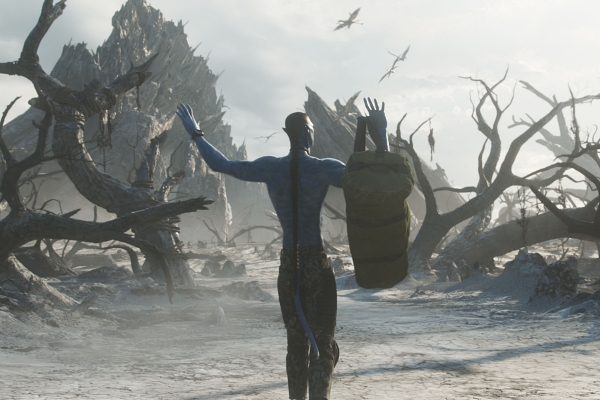
James Cameron is too good of a director to spend the rest of his career trapped in Pandora. Avatar: Fire and Ash, the third of five planned installments, may be the most unequivocal waste of time and talent in any major motion picture this century. At three hours and 17 minutes, this second sequel is the neglected middle child of the franchise—adrift, unsure of its purpose, and mostly forgotten even as it plays out in real time. Despite its nearly endless runtime, so little actually happens that the movie ends in almost the exact same place it began. It’s a truly depressing chapter in a franchise that began with a box-office-destroying splash in 2009 and (shockingly) managed to carry the flame with The Way of Water, a disappointing but still absurdly profitable sequel.
Here, the story beats, aesthetics, themes, and characters are all carbon copies of the previous installment. Nothing has changed. There’s nothing on the page to suggest this movie needed to exist as its own standalone entry, let alone as a three-plus-hour epic. Cameron has truly gone native here, lost the plot, and abandoned all his other creative endeavors to chase the banshees of Pandora, a fact that should have been evidenced by the sheer audacity of planning five of these things to begin with. If Fire and Ash is any indication of what’s to come, we’re in for a brutal slog to the bitter end.
Cameron recently claimed that if Fire and Ash doesn’t do gangbusters at the global box office—a feat requiring a haul of at least $1 billion—he might walk away from the franchise entirely, effectively killing the series, as he doesn’t believe any other director could carry the torch to finish the last two films. He may think of this as a threat, but I take it as a promise. I’d love to see Cameron take his considerable skill set and apply it literally anywhere else. Pandora has been ravaged and picked over, by both the air-breathing pink-skins in the film and the creative ones behind the scenes.
It doesn’t help that the visual effects, which once felt groundbreaking and pushedthe limits of cinematic spectacle, now look dated and bothersome. Everything resembles a video game cutscene, especially in the opening moments when two Na’vi brothers race their banshee mounts around floating mountains. Before your eyes can even adjust to the cumbersome 3D glasses, the effects already look shoddy and cheap. That’s not to say everything in Fire and Ash is a visual disaster—Cameron still knows how to stage an effective set piece and occasionally find clever framing—but the showstopper sheen is gone. This movie simply doesn’t look good. Even the last one, The Way of Water, introduced underwater elements that at least felt novel, a gimmick that elevated an otherwise uninspired sequel. This one doesn’t even have that. It’s visually indistinct and narratively empty; a high-frame-rate fever dream with nothing new to add.
Following the death of his brother Neteyam, Lo’ak (Britain Dalton) struggles to find his place within his tribe. His parents, Jake (Sam Worthington) and Neytiri (Zoë Saldaña), cope with grief in predictably divergent ways—she withdraws; he throws himself into combat. Meanwhile, Colonel Miles Quaritch (Stephen Lang) is once again gunning for Jake Sully and his family, this time with backup from the Ash People and their incendiary leader, Varang (Oona Chaplin). As the war between Na’vi and humans escalates (again), it falls to Jake to rally the clans and convince the whale-like Tulkuns to join the fight for Pandora’s future.
[READ MORE: Our review of ‘Alita: Battle Angel‘ produced by James Cameron and starring Rosa Salazar]
That summary might sound suspiciously like The Way of Water because it basically is. The two films are so structurally similar that entire sequences feel lifted wholesale from the previous entry. The subplots this time around—Lo’ak bonding with a fellow outcast Tulkun, Kiri (Sigourney Weaver) discovering she can sync with the literal ground, and Spider (Jack Champion) finally learning to breathe the air like a real Na’vi boy—are apparently considered the emotional and thematic heft of this sequel. Whether they actually do anything other than get captured a bunch is another story. For all its epic length and self-serious tone, Fire and Ash has startlingly little to add. It grazes the edges of some already well-trod themes—adoptive family, the idea that love runs deeper than blood, and of course the ever-present eco-allegory that’s now so overcooked it might as well come pre-packaged with a Greenpeace donation form. But there’s nothing new here. Nothing that adds complexity or even feels all that thought through. The film even gestures at more compelling threads, like Jake’s reluctance to fully step into his role as Toruk Makto, the prophesied leader meant to unite the clans and actually do something about the human military presence on Pandora. But then just moves on. At one point, Lo’ak mentions in voiceover that his dad gave a “really inspiring” speech to rally the Na’vi. What we get is a single, mangled sentence fragment about bundled arrows. Apparently, actually showing that speech would’ve required writing it, and who has time for that in a script with no less than a dozen indistinct action sequences.
That’s the real kicker: this movie is nearly three and a half hours long, and it yada-yadas through every moment that might carry emotional or narrative weight. Instead, it fills the runtime with an endless cycle of capture, escape, recapture, escape. On loop, forever. Even Varang, who could’ve been a compelling addition to the series—a Na’vi leader desperate for power, willing to forsake Eywa, seduced by mankind’s firepower and machinery—feels like an afterthought. Concept sketch as character. Her presence seems to exist solely to justify the addition of yet another newly-colored Na’vi tribe in this increasingly overpopulated franchise. The tragedy is that with each new film, the brand feels more and more diluted. Sure, the coffers keep getting fuller, and apparently people are still willing to buy tickets for the 3D IMAX experience, but Fire and Ash should serve as a true litmus test for how much audiences are willing to endure just to keep visiting Pandora. Consider my ticket to orbit punched.
CONCLUSION: Overlong, repetitive, and dull, ‘Avatar: Fire and Ash’ commits the cardinal sin of being both excessive and unnecessary, adding little to the Pandora saga and failing to justify a return to this overstimulating world. Let’s just hope James Cameron hangs up his hat here so he can focus on better things for the remainder of his career.
C-
For other reviews, interviews, and featured articles, be sure to:
Follow Silver Screen Riot on Letterboxd
Follow Silver Screen Riot on Facebook
Follow Silver Screen Riot on Twitter
Follow Silver Screen Riot on BlueSky
Follow Silver Screen Riot on Substack
The post ‘AVATAR: FIRE AND ASH’ Is a Punishing Retread With Nothing New to Add appeared first on Silver Screen Riot.