By
By 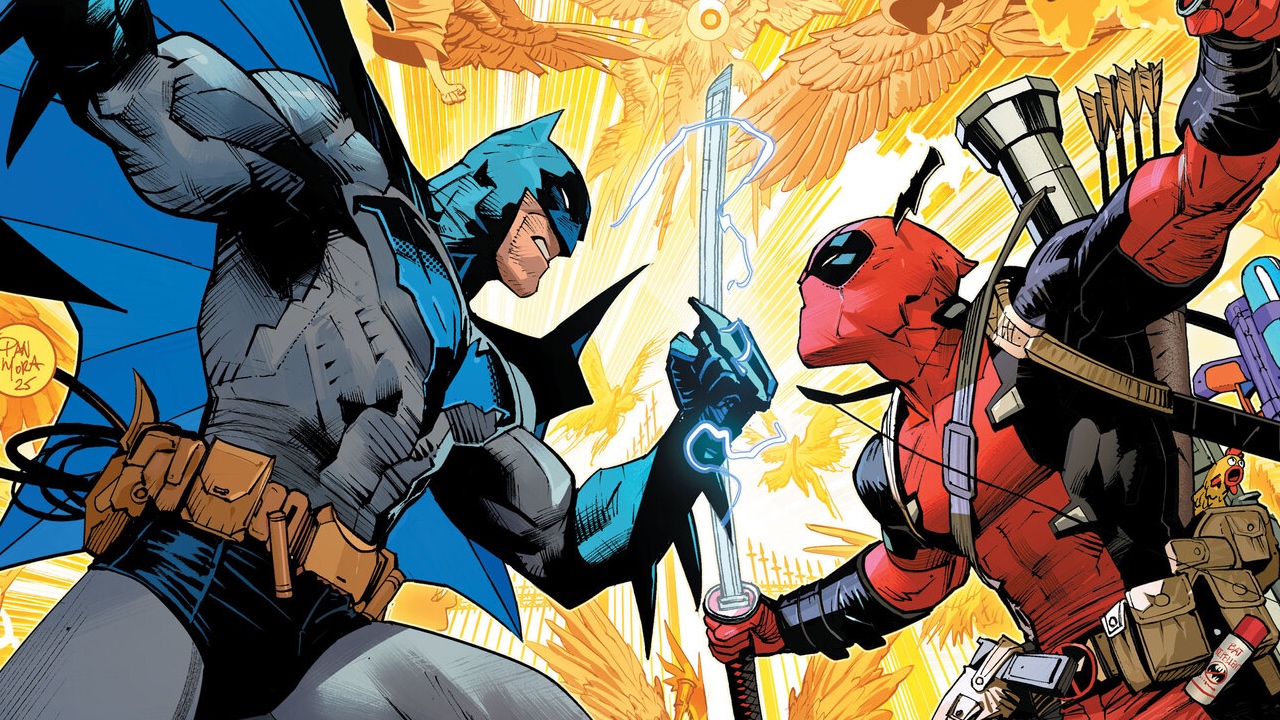
This article contains spoilers for Batman/Deadpool #1.
1990 saw the debut of not one, but two of comics’ most notable fourth-wall breakers. In December’s The New Mutants #98, readers met Wade Wilson a.k.a. Deadpool, the Merc’ With a Mouth–then just a Deathstroke and Terminator rip-off and not the self-aware figure he’d become. A few months earlier, Animal Man #25 introduced the Writer, a kind Scottish person who welcomes Animal Man Buddy Baker into their home and explains that they are the cause of all the heroes’ suffering because they are Grant Morrison, the writer of the comic.
At least, we thought that the Writer is Grant Morrison, especially when the character showed up in last month’s Batman/Deadpool #1, written by Morrison and penciled by Dan Mora. But in the latest edition of their newsletter Xanaduum, Morrison clarifies things by making the character more complicated. “Contrary to speculation, The Writer character here is not me,” writes Morrison. “The Writer on this and subsequent pages is the one who appeared in HBO Max’s Titans, at the end of season 4 episode 9 – Dude, Where’s My Gar! – as written by Geoff Johns.”
Unlikely as it is for any character specifically from the live-action Titans series to show up in the comics, it actually makes sense for Batman/Deadpool and especially for the Writer. Morrison returns to the jet-setting, James Bond-inspired version of Batman he wrote years ago to team a wryly funny version of the Dark Knight with Deadpool as the duo navigate a new world created when a tryst between cosmic entities merges the DC and Marvel Universes. As Batman deflects Deadpool’s motor-mouth observations with dry one-liners, the two encounter all manner of deep cuts from the two comic company’s past, including an appearance by Dark Claw, the Batman/Wolverine mashup from a previous intercompany crossover.
At the end of the story, the heroes find the root of the problem. Onto the page walks the Writer, a bald person in a suit, who explains to Batman and Deadpool that they all serve the word processor in his hands and, more importantly, the expectations of the audience. Even when the story’s ostensible big bad Cassandra Nova, whom Morrison created as part of their X-Men run, tries to control the Writer’s mind, the Writer simply explains that this too was determined by the script.
Such has always been the Writer’s modus operandi. The character first appeared at the end of a particularly nasty storyline in Animal Man, in which the silly D-lister Buddy Baker had his life torn apart when his family was brutally murdered. Buddy gets dark and gritty in his search for revenge, only to meet the Writer at the end of it all. The Writer explains that ’80s comic book fans reject goofy heroes and want something dark, which is why Buddy’s family had to die. But choosing their own creative impulses over the demands of fans, the Writer ultimately decides to restore Buddy’s family and status quo.
In 1990, the Animal Man arc felt revolutionary. Like Alan Moore and Frank Miller, Morrison was interested in deconstructing superhero comics and examining their basic construction. But not only did Morrison avoid the darkness of those two creatives’ work at the time, reducing the death of Buddy’s family to an already obvious and tired trope, but they did so through the perspective of the character. The scene in which Buddy turns around, faces the audience, and shouts, “I can see you!” remains powerful, even after endless homages (including one by Morrison themselves in Batman/Deadpool).
Morrison went on to do more wonderful metatextual work, in the not-crossover Seven Soldiers, the pseudo-gospel All-Star Superman, and the all-encompassing epic The Multiversity. But even they recognized the limitations of the Writer as a character and didn’t gripe when the character died as a member of the Suicide Squad just one year after their debut. Of course, neither did Morrison refrain from stepping from behind the word processor and onto the screen to portray the Writer in live action, in the aforementioned episode of Titans.
But that just makes Morrison’s clarification about the Writer’s identity in Batman/Deadpool all the more interesting. By insisting that they are not the Writer and reminding us that Geoff Johns wrote the script for that Titans episode, Morrison makes the Writer bigger than themselves. No longer is the Writer a stand in for just one Scottish magic practitioner and author of comics. Rather, the Writer is anyone who tells a story, even if that story is about Beast Boy crossing the multiverse in live action or a humorless Deadpool trying to kill the New Mutants.
Batman/Deadpool #1 is now available at your local comic shop.
The post Batman/Deadpool Puts a New Twist on Grant Morrison’s Most Metatextual Character appeared first on Den of Geek.