By
By 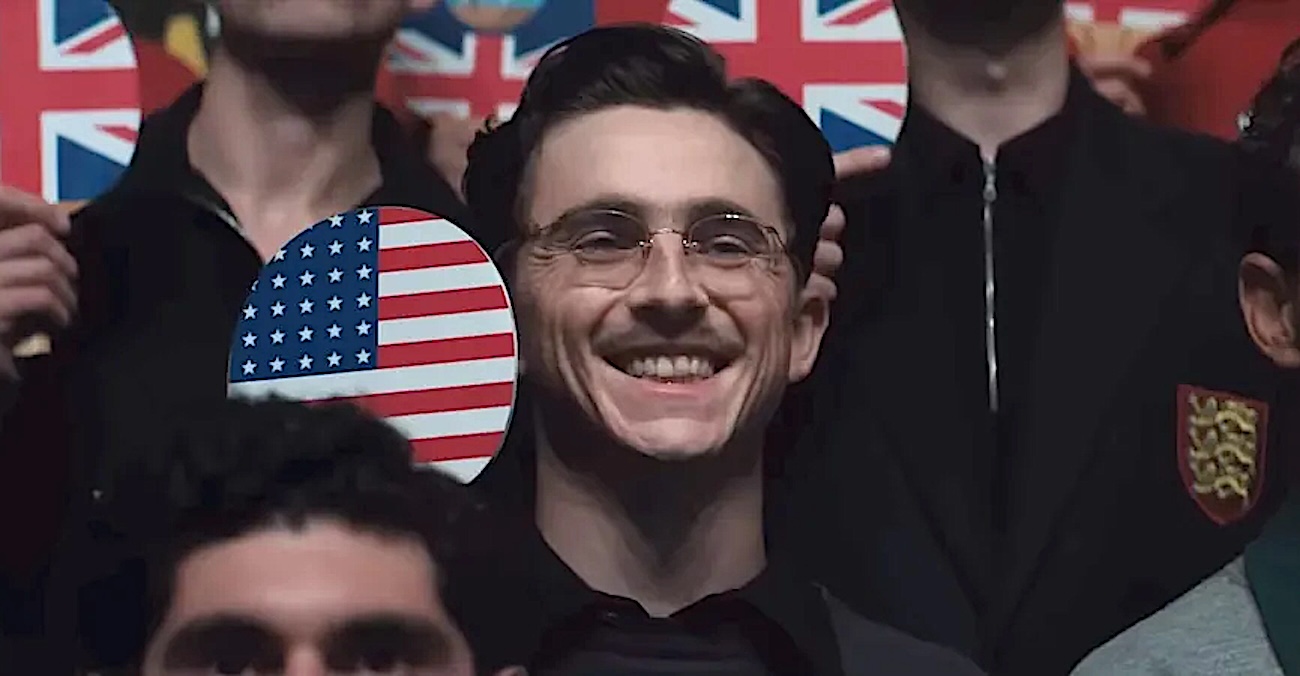
For four millennia, the Pyramids of Giza have captured the imagination of any and all travelers who wandered into their plateau. As someone who’s crossed those sands, I can attest that words fail to convey their ancient allure. It’s a sight filled with solemnity and awe. And in Josh Safdie’s Marty Supreme, one of the best gags occurs when Timothée Chalamet takes a hammer to them with a smile.
Just to be clear, there is nothing malicious about Chalamet’s eponymous Marty Mauser going full Thor on the famed building blocks. As he tells his Jewish mother back in New York—where he’s gift-wrapped her a chunk of limestone—“we built that!” Still, one cannot help but suspect the hard-swaggering and harder-living Marty views the appropriation as a kindness too. Here is a relic from legend which has outlived its original purpose. But now, thanks to Marty, the stone enjoys new meaning by what our hero unquestionably views as the start of another myth that’ll live through the ages. The trick about Safdie’s film is that it’s likewise convinced of that good word and spreads it with the zeal of a proselytizer. On the surface Marty’s story and film has all the markings of a familiar sports yarn, this one about a table-tennis hustler from the Lower East Side; in practice, it’s an epic with the chutzpah of Moses.
This is also one of the tamer examples of how radically arrogant and aggressively ingratiating Chalamet’s best performance to date can be. Whether it’s holding up a co-worker at gunpoint in order to withdraw a paycheck early—he needs the money to finance a trip to the UK for table tennis’ 1952 British Open—or telling the press that he’ll finish what Auschwitz started against his Holocaust-surviving rival in the same tournament, Marty is a big skillset with a bigger mouth; an addict drunk on the ego of youth and the delusion that talent and charm will always be enough. As a piece of cinema, it sure as hell is. For our protagonist… well, that remains the great tension of the movie.
Set entirely during a tumultuous year in Marty’s life beginning in ’52—while also giving the impression that every other would be much the same—Marty Supreme tracks Marty’s travails from that British Open to the World Table Tennis Championships in Tokyo. But while Safdie and Chalamet shoot the eventual ping-pong matches with electricity and flash to match the star’s showmanship, this is not really a sports movie. Rather it’s another Safdie film about a hustler who bites off so much more than he can chew that it is only by the virtue of never finding time to shut his mouth and swallow that he avoids asphyxiation.
A day in the life of Marty’s exploits include—but are not limited to–both wooing and insulting the deep pockets of a prospective patron who would fly him to Tokyo (Kevin O’Leary at his most WASPy), sleeping with the said patron’s older movie star wife (Gwyneth Paltrow), scamming a bunch of hicks in a New Jersey bowling alley with good pal Wally (Tyler, the Creator), pressuring another more gullible buddy (Luke Manley) to invest in Marty’s vision for cornering the market on orange ping-pong balls, generally taking years off the life of his mother (Fran Drescher), and absolutely, positively refusing to settle down with his childhood best friend Rachel (Odessa A’zion). Who, by the by, is eight months pregnant with Marty’s child for much of the story and has been cast out of the home of her abusive husband. And I haven’t even mentioned the mafia yet.
Safdie apparently based much of the fictional Marty Mauser on real-life table-tennis champ Marty Reisman, a figure so infamous in mid-20th century NYC ping-pong halls that he was known as “the Needle” for both his sharp frame and sharper tongue. But truthfully, other than what I just nicked off Reisman’s Wikipedia page, I have no idea how much of the real-man’s biography Safdie drew on for this film. Given the increasingly incredulous scenarios and now-familiar viselike dread that director and co-writer Ronald Bronstein cultivate in their narrative, I would hope not much.
For all intents and purposes, Marty Supreme is a spiritual prequel and heir to Josh Safdie’s last film, Uncut Gems, which he co-directed with his brother Benny. Since that picture, it would seem the Safdie Brothers have gone their separate ways, but whereas Benny chose to make a traditional sports biopic devoid of the bizarre tragicomic tension that underlay Uncut Gems and the even earlier Good Time, Josh and Bronstein (who also co-wrote Uncut Gems) have doubled down like their onscreen gamblers on tracing the mania and terror that comes from living life at constant full-tilt.
What makes Marty Supreme such a worthwhile and unique companion, then, isn’t that it just duplicates Uncut Gems’ peculiar marriage of suspense and gallows humor, but that it comes at it during an entirely different stage of life. In Uncut Gems, Adam Sandler’s Howard Ratner is also boastful, high-handed, and living his life at the constant inflection point between survival and cardiac arrest. The thing is that Sandler’s middle-aged and hunching Howard knows his house of hustled cards will probably collapse soon.
Chalamet’s perpetual youthfulness betrays the naiveté beneath Marty’s egomania. At 23 years old, this kid never seems aware there’s a good chance he won’t make it to 24 when he’s ripping off the mob to scrounge together enough money for a plane ticket to war-torn Tokyo. And when he woos Paltrow’s bored Kay Stone, Marty is just fresh-faced enough to never consider that he’s more her distraction than any kind of transgressive revenge against the blue-blood ruling class on 5th. If this point were not blunt enough, Safdie scores the film’s opening credits sequence to a souped-up rendition of Alphaville’s “Forever Young.” Furthermore, those credits mirror Uncut’s elegiac opener, which turned out to be a microscopic, but galaxy-brained vision of Howard’s colonoscopy (and mortality); Marty’s, by contrast, is of a determined sperm making a triumphant swim toward the endzone.
It is easy to imagine Chalamet’s Marty one day becoming another Howard Ratner, should he live so long, yet by grace of bloom, not to mention Chalamet’s own indefatigable charisma, such a destiny seems eons away. In the meantime, viewers are asked to bask in the type of performance Chalamet has been waiting for. A little older and more seasoned now that he’s near 30, or just doing a decent job of hiding beneath a will-o’-the-wisp’s worth of facial hair, Chalamet indulges Marty’s rough edges and vanities with the glee DiCaprio similarly displayed when he finally shook off coming-of-age parts to play one of Hollywood’s most storied bastards in The Aviator.
Chalamet likewise revels in this protagonist’s seediness while employing the same bouncy joie de vivre that turned him into a star in the first place during Call Me By Your Name. You cannot help but like this guy, no matter how much of a prick Marty consistently proves to be with his friends, enemies, and even lovers. That spark could dim one day, but for this narrative it never drops beneath a defiant roar.
It is Chalamet’s show, with the actor in nearly every scene during the two and a half hour movie, and the narrative is never anything less than addictive, even when it purposefully twists the anxiety knife. Chalamet gets a lot of help, however, from a supporting cast that includes a couple of great supporting turns. A lot will be made out of Paltrow conjuring some Old Hollywood glamour (and weariness), but it is A’zion who lingers in the memory as a woman who is as tenacious as Marty, but whose sometimes sad, and other-times calculating, eyes deserve so much better.
All parties, plus many NYC locals and non-actors, are harnessed by Safdie to create a period drama that feels of a piece with its post-World War II setting but vitally alive in the here and now for its audience. The anachronistic soundtrack filled with 1980s synthesizers and pop ballads probably doesn’t hurt in that regard. In fact, it heightens the Tears for Fear-like mania for world domination in Marty’s compulsions. Somehow, these disparate elements complement and converge, serving Sadie’s larger impulse to match and exceed Uncut Gems’ magic trick by keeping folks on the edge of their seats for now 149 minutes. If Uncut was a feature-length heart attack, Marty Supreme is a just as expansive dopamine-hit of euphoria; and it’s so strong one doesn’t notice the knife being slipped in between bouts of nervous laughter.
Marty Supreme premiered at the New York Film Festival on Oct. 6 and opens in the U.S. and UK on Dec. 25.
The post Marty Supreme Review: Timothée Chalamet Scores Big in Spiritual Uncut Gems Prequel appeared first on Den of Geek.