By
By 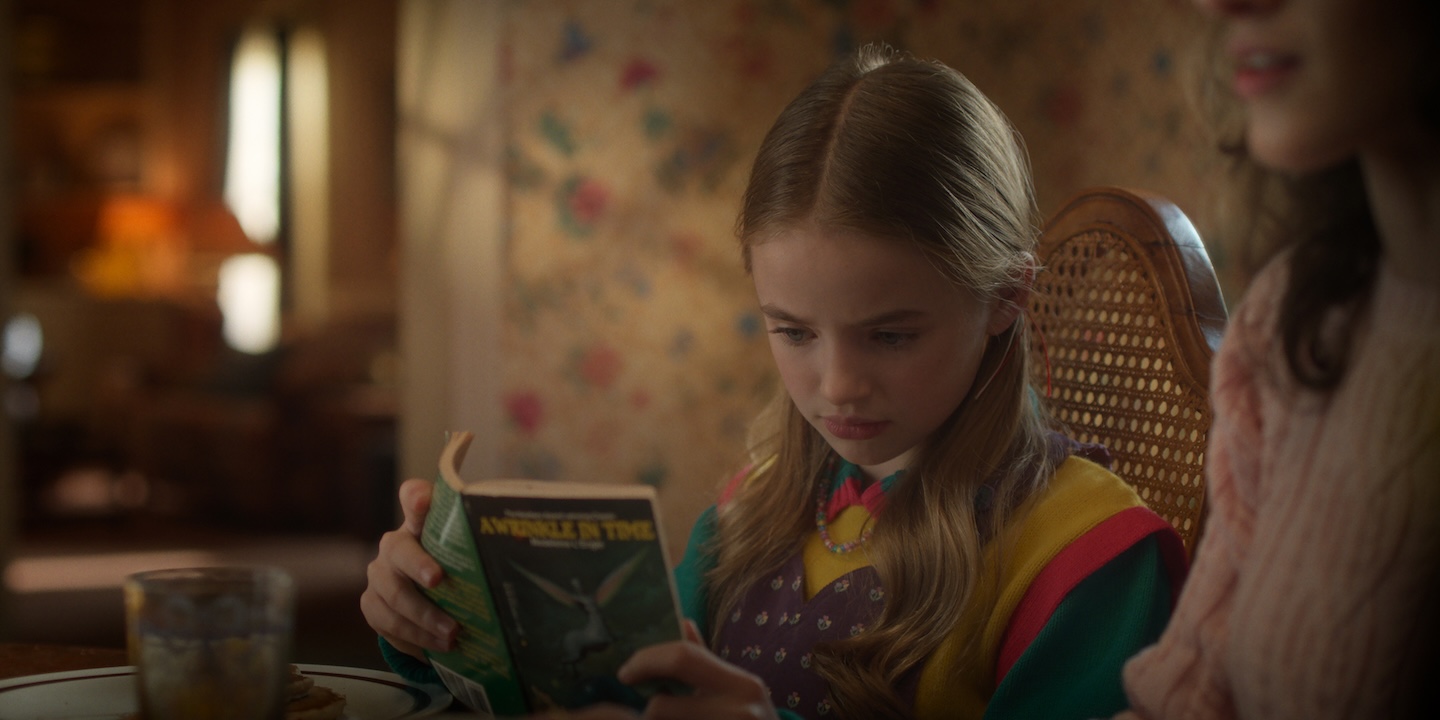
This article contains spoilers for Stranger Things season 5.
At the end of Madeleine L’Engle’s 1962 sci-fi fantasy novel A Wrinkle in Time, the witch/interdimensional being called Mrs. Whatsit compares human life to a sonnet, the poetic form defined by its strict 14-line structure. The correlation annoys Calvin, a teen from a troubled family who finds meaning in an adventure across time and space with neighbor Meg Murry and her family. When Calvin takes exception to having such restrictions on his life, Mrs. Whatsit offers an explanation. “You’re given the form, but you have to write the sonnet yourself,” she points out. “What you say is completely up to you.”
In its fifth and final season, what Stranger Things wants to say comes from A Wrinkle in Time, at least in part. In the season premiere, we see the novel in the hands of Holly Wheeler, younger sister to Nancy and Mike. As the Wheeler family comes under the attack of Vecna’s forces, Holly uses references to A Wrinkle in Time to make sense of what’s happening to her. To fans of the novel, Holly’s A Wrinkle in Time talk might point to some of the plot points and themes that Stranger Things plans to explore as it says goodbye.
Who Is Mr. Whatsit?
The most obvious A Wrinkle in Time nod comes in the name that Holly gives her imaginary friend. In the first few episodes, Holly talks about Mr. Whatsit, a person that others dismiss as just her way of dealing with familial tensions, but we viewers understand as real. Although we cannot initially see his face, we see Mr. Whatsit, nattily-dressed in a tan suit, visiting Holly and treating her kindly. Later episodes reveal that Mr. Whatsit has visited several children in Hawkins, offering to take them to someplace kind and loving.
Given his odd but reassuring demeanor, it’s easy to see why Holly dubbed this man Mr. Whatsit. The Mrs. Whatsit of the novel can sometimes frighten Meg, her brother Charles Wallace, and Calvin—the novel literally begins with the lines “It was a dark and stormy night” to describe the storm in which Mrs. Whatsit arrives—but she radiates kindness. Moreover, Mrs. Whatsit is the conduit through which Meg finds her missing father, a scientist who learned to travel across time and space via a process called tessering, and also helps she and her friends see their worth.
Mr. Whatsit, it seems, is something very different. Eventually, we learn that he is in fact Henry Creel, the man who will become Vecna, and may be Vecna presenting himself to Holly in a kinder, more welcoming form. During a demogorgon attack on the Wheeler home, Holly is kidnapped and taken into the Upside Down, where she exists in a reality based on Creel’s past, an apparently warm and welcoming house where she can do anything she wants, except go into the woods.
On the surface, Holly’s comparison of Creel and Mrs. Whatsit seems like a fatal mistake on the little girl’s part. Her insistance on seeing a kind magical creature based on a character she loves, instead of seeing a monster, may have horrific consequences.
However, previous seasons of Stranger Things have suggested that Creel and Vecna may be different personalities within the same person, and that some goodness may still reside in the Creel identity. Could it be that Holly recognizes that goodness within the Creel who comes to visit her? Could she be calling forth that goodness by naming Creel after another powerful, odd, but ultimately good figure, dubbing him Mr. Whatsit?
The fact other children who have seen Creel also call him Mr. Whatsit could undermine that theory, especially given Vecna’s claim that he hunts children because they’re easy to manipulate. But if Mrs. Whatsit taught Meg anything, it’s that children can stand up to the forces of darkness. That’s a lesson Holly will need to keep in mind.
What Is Camazotz?
Eventually, Holly does go into the woods that Mr. Whatsit prohibited, and reunites there with Max Mayfield. Max explains to Holly about how Vecna controls the Upside Down and this reality, forcing everything in his own image. Max’s explanation makes perfect sense to Holly, because it reminds her of a location in A Wrinkle in Time: Camazotz.
Meg, Calvin, and Charles Wallace find Camazotz in the novel’s climax. At first, Camazotz appears as a sedate, if dull, suburb. Apropos of the 1960s milieu in which L’Engle wrote, the suburb was the height of conformity, all identical houses and indistinct lawns. But the children soon notice something darker lurking within the perfect houses, signaled by the fact that every house has a child in front, each bouncing a red rubber ball in exact perfect rhythm.
As the children investigate further, they realize that the rhythm matches that of IT, the novel’s primary antagonist. IT exists only as a pulsating brain at the center of a bland office building in the middle of Camazotz. It communicates either via possession, taking over Charles Wallace at one point, or through his servant, known only as the Man With Red Eyes. Everything within Camazotz conforms to IT, moving at the same rhythm that IT pulsates.
A Christian mystic writing in the period of America’s post-World War II ascendency, L’Engle associated IT with everything saw as wrong and evil in the world. In particular, IT represented oppressive conformity, which choked out the beauty and individuality of creation. Meg, Charles Wallace, and Calvin make such good warriors against IT precisely because they’re outcasts who cannot conform to the world.
By identifying Vecna’s worlds as Camazotz, Holly acknowledges the monster’s desire to corrupt the world until it’s like him. But the connection also has deeper thematic ties, as Stranger Things‘s final season is deeply concerned with teens learning to accept themselves. The first episodes most obviously outline that theme in Robin’s monologue about coming out to herself and falling for Vickie. She describes the realization as something akin to flying, a metaphor that stands out to A Wrinkle in Time readers, given a memorable passage in which Mrs. Whatsit transforms into a winged creature to carry the children across the sky.
Like Meg, Charles Wallace, and Calvin, the kids of Hawkins resist Vecna best when they’re simply allowed to be themselves.
Speaking Within the Form
Then again, the Wrinkle in Time references may be just that: references to culture popular in the 1980s. Stranger Things certainly has no problem winking to movies and television shows that creators the Duffer Brothers like. Certainly, those references sometimes have significant plot and theme relevance, as with the Dungeons & Dragons language that has been a mainstay of the series since season one. Other times, it’s a Kate Bush needle drop or an Evil Dead poster on the wall, little more than set dressing.
And that’s okay. Anyone who tried to slavishly recreate A Wrinkle in Time would have missed the point of the novel, following the logic of IT more than Mrs. Whatsit or her sisters.
After all, Madeleine L’Engle simply provided a form for fantasy science fiction. What anyone says with it is completely up to them.
Stranger Things season 5 episodes one through four are now streaming on Netflix.
The post Stranger Things Season 5’s A Wrinkle in Time Connections Explained appeared first on Den of Geek.