By
By 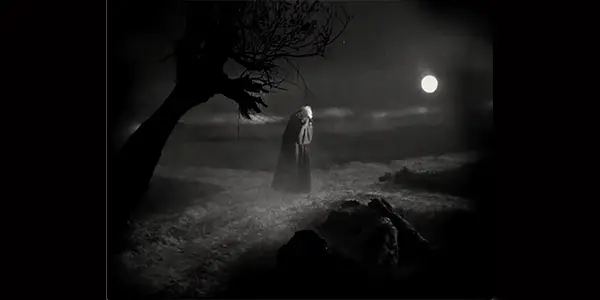
Cinema was never silent.
When Thomas Edison filed a patent in 1888 for a machine that could project still images fast enough to foster the illusion of continuous motion, his stated goal was to “do for the eye” what his phonograph did for the ear. The medium of cinema was always intended to be both a visual and an auditory experience.
Early versions of Edison’s Kinetoscope used a belt to connect the revolutions of his audio discs to the rotations of film reels. But these devices proved impractical, leaving the great movie palaces that were eventually constructed in the 1910s to allow room – as live performance venues long had – for the presence of live musicians and narrators to accompany the exhibition of a film. The movies quickly grew in popularity, but their deep roots in live theatrical performance remained prominent and unmistakable well into the 20th century.
Not until the late 1920s would audio be recorded directly onto film as magnetic strips running alongside the sprocket holes, allowing for the mechanical reproduction of sound in synch with the moving image. Most histories of sound in movies point to Al Jolson’s 1927 blackface melodrama The Jazz Singer as the breakthrough, the film that ushered in the era of the “talkies,” dramatically altering not only the experience of watching a movie, but also the architecture of movie houses, and, eventually, the entire economy of entertainment.
But live musical accompaniment of films never went completely away. To this day, college and university film studies programs stage live accompaniments of old films to provide an experience that can simulate the early days of feature films, and symphony orchestras host series of beloved films from across the decades, ranging from The Wizard of Oz to the original Star Wars trilogy to Peter Jackson’s epic CGI adaptations of The Lord of the Rings. The live musical performances offer fans an opportunity to experience old favorites with fresh eyes and ears.
Another form of revival is the matching of a specially composed popular music score to art house films, particularly silent classics that were made too early for pre-recorded soundtracks. These films, with their steady flow of black-and-white images that suggest bygone eras that have been analyzed, deconstructed, romanticized, mythologized, and appropriated for various political and cultural purposes over the last century, offer a rich background for musical artists to set their compositions to – and against.
Source: Kino
One of the most suggestive musical idioms for such impressionistic treatments is heavy metal, a genre with a complex history of its own. With iconography that can be traced back to the Middle Ages, metal can hold a particularly skeptical and revealing mirror up to old films and, using those old films, to postmodern culture itself.
As metal scholars Ruth Barratt-Peacock and Brenda Gardenour Walter put it, “These fragmented facets of the medieval are used by metal musicians and consumers as a means of collective resistance against the post-enlightenment, capitalist, machine-mediated present by re-enchanting it with a transcendent, organic, and carnal past” (Medievalism and Metal Music Studies: Throwing Down the Gauntlet (2019), p. 138).
In this context, the work of the heavy metal film music group known as The Silent Light to provide metal scores for silent films is not just an act of nostalgia. The Silent Light works, as part of its mission, to help old movies appeal to new, 21st-century audiences. But even as the band’s musical presentation serves the films with a postmodern close-up, it also suggests new connections between older modes of thought and culture that root the films still more firmly and suggestively in the past. History too can be in the eye – and ear – of the beholder.
In his responses to the questions below, Mike Formanski, director of The Silent Light, draws on his dual backgrounds in filmmaking and music to explain the challenges and triumphs of wedding metal music to old movies. While it seems a safe bet that Ozzy Osbourne never met F. W. Murnau, in the efforts of Formanski and his bandmates, their worlds are artfully conjoined, endowing old films with striking new voices.
Film Inquiry (FI): What is your background in film? And in music?
Mike Formanski (MF): My background in film began in the film directing program at CalArts. After graduating, I spent several years working as a cinematographer, shooting a wide range of music videos along with a narrative feature called Death and Bowling. From there, I started working as the Creative Director for Moby’s production company, Little Walnut, where I made a whole bunch of his music videos, worked on features that he was developing, and made anything that needed to be made in the visual media realm.
As far as music goes, I started learning how to play guitar when I was 13 and began writing music soon after. Through high school, I was pretty drawn to black metal, which is where a lot of my core musical influences still come from. I don’t have any academic background in music, and I kind of prefer to keep it that way. I don’t want to get caught up in the theory behind the music we’re making.
FI: How did you come up with the name “The Silent Light”?
MF: The Silent Light is a reference to one of the songs from the Chrono Trigger soundtrack. Composers like Nobuo Uematsu, Yasunori Mitsuda, and that whole era of ’90s JRPG fantasy score music are some of the most inspirational to me personally.
FI: What is it about heavy metal music that lends itself to silent-era films? (And vice versa?)
MF: I think this functions on two levels. One of the things about the metal that we’re performing is that we’re able to elevate the score to an even higher level of intensity than what’s typically accessible with classical orchestration, for example. When we can actually make the walls of the theaters shake, it’s hard to escape that level of intensity. Secondly, we’re working in a style of music that connects more directly with a modern audience. At the end of the day, what we’re doing is based on rock and blues. I find that the audience has such an easier time accessing the stories in some of these old films when we can use a more modern style of music to serve as a bridge between now and a hundred years ago.
FI: How do you choose the films you want to score? Which one proved the hardest to score, and why?
MF: There isn’t really a specific process to deciding on the film. It happens kind of organically; if one of the universities or theaters we perform with is excited about a specific film, we’ll focus on that one next. As of yet, the most challenging film to score would be Kinugasa’s A Page of Madness. Mostly because the film is so abstract; there’s no dialogue, so it takes a lot of close attention to find the threads that pull the narrative forward.
Source: Kinugasa Productions
FI: What was your first live accompaniment performance? What challenges that you did not anticipate did you have to handle during the performance? How does live film accompaniment compare to other live performances you’ve given?
MF: The first live film score was Faust in 2015. The main difference between performing a live score as opposed to a solely musical performance is that with just music, you are providing the entire experience with the show. With a film score, our job is to guide the audience through the story of the film. We are just storytellers; we aren’t supposed to be the focus of the show, which is why I typically ask venues not to put any lights on us since I’d prefer that the audience’s main focus goes to the film itself.
FI: What difference does the venue make in your preparations for a live performance? Which ones have worked best, and which proved most challenging?
MF: Not a huge difference actually. We’ve performed in tons of indie movie theaters, which are usually very old buildings with tons of character, as well as grungy DIY warehouse spaces and cleaner, more up-to-date university theaters. Each type of space brings something unique to the show. The only real challenges have come from occasional disorganization at a venue, which has only happened once or twice.
FI: What are some of your favorite films and scores?
MF: Favorite films: Daisies, Pat Garret and Billy the Kid, Contempt, Vagabond, Ghost in the Shell (1995), Dog Day Afternoon
Favorite scores: Final Fantasy VII, IX, X; Ghost in the Shell (1995), Akira, Shadow of the Colossus, Cowboy Bebop, Once Upon a Time in the WestFI: What are your dream projects for the Silent Light?
MF: I used to always say that I wanted to perform one of our scores with a big choir, and we just did that during this current tour. We performed The Passion of Joan of Arc with a 50-person choir at UNCSA, which was a really special show. From there, I would say I just want to become the guy that people call when they need a dark fantasy soundtrack.
Film Inquiry thanks Mike for taking the time to chat with us! You can check out The Silent Light here.
Does content like this matter to you?
Become a Member and support film journalism. Unlock access to all of Film Inquiry`s great articles. Join a community of like-minded readers who are passionate about cinema – get access to our private members Network, give back to independent filmmakers, and more.