By
By 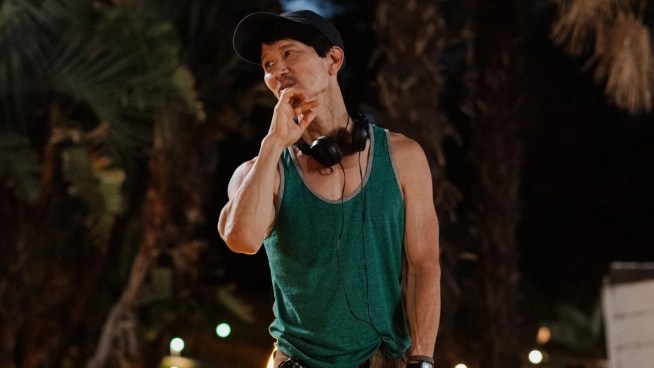
Before we’d exchanged more than a few words, Gregg Araki was already laughing. He spotted the blue “HO LIFE OR NO LIFE” hat I’d chosen for the interview and asked whether I had worn it specifically for him. “Of course,” I told him. Given the nature of I Want Your Sex, it felt appropriate. I mentioned that between this and Pillion, 2026 was unexpectedly becoming the year of the sub/dom drama, and asked about the film’s fine lines between fantasy and violence, eroticism and performance, kink and humiliation, and a consensual power exchange complicated by a wildly inappropriate boss-employee relationship. What did he hope audiences would consider about navigating those sexual boundaries for themselves? “My idea for the movie was that I wanted to put something out there that was fun and pop,” Araki said. “I really like Pillion, but it was kind of dark. The tone was very different from what I Want Your Sex is interested in. The world—particularly America—is so fucked up right now. I didn’t want to make something too dark or gruesome or dystopian. I wanted to put something out into the world that was full of queer joy.”
Asked what kinds of conversations he wanted those ideas to inspire, Araki emphasized that his fun-first approach was never intended to produce empty calories. “I wanted people to have a fun night at the movies. It’s purposefully ninety minutes: in and out. Go with your friends. Have a laugh. Have a good time,” he said. “But it’s not meant to be empty popcorn fluff. There’s clearly a lot on my mind thematically. In an ideal world, people will go have a good time at the theater, go out for a drink afterward, and talk about it. Have a conversation, have an argument, pick a side and argue about it, the way Elliot and Erika sit on the couch and have that conversation about Gen Z and sex. I don’t mean the film to be a lecture, but I do want it to provoke conversation. I want people to think, and I want people to communicate.”
There’s a belief running through I Want Your Sex that we’re never more exposed than during a sexual encounter. Not merely physically, but emotionally. Sex becomes a language and a dance, sometimes a painful one, through which we may know our partners more intimately than our closest friends or family. At the same time, America appears to be swinging toward a strangely puritanical, sex-fearful moment, particularly among younger generations. I asked Araki whether that cultural retreat might be quietly costing us the ability to connect with one another, or whether some portion of the anger and misery surrounding us is simply rooted in people not having enough sex. “I’m old. I come from a different generation, but I totally believe in ‘make love, not war,’” he said. “There’s so much anger, misery, fear, and hatred in the world right now. How much of that is just from all of this repression?”
The most malignant expression of that repression, in Araki’s view, can be found in online incel culture. “There’s nothing more horrible to me than these incels that are just so nasty and so angry and so bitter and so violent. They hate, hate, hate, hate people,” he said. “It’s like, dude, fucking chill out. Touch grass.” Having come of age during the sexual revolution and gay liberation, Araki views openness around sexuality and queerness as hard-won progress rather than some social ill in need of correction. “The openness of society in terms of sex, sexuality, queerness, gay liberation—all of it—is huge progress in my eyes,” he said. “Trying to clamp down on all that and stuff everybody back into the closet, back into those dark ages when people were so bottled up and miserable, is super unhealthy. That’s my take on it.”
Olivia Wilde is intoxicating as Erika Tracy, a terrifying, intimidating, impossibly seductive art-world dominatrix with a dark, matter-of-fact view of life as an exchange economy where nothing has inherent meaning and everything is performative. At one point, she explicitly declares, “Contemporary art is a scam. The real art is convincing people that you’re making something meaningful and complex when it’s really just arbitrary masturbation.” The following day, Erika admits she was basically making up bullshit. I asked Araki how much of her cynical philosophy reflected his own worldview or functioned as commentary on his art. “That’s why Olivia was so excited about the part, because it’s such a fun character,” he said. “She’s larger than life. She says the craziest shit. She does the craziest shit. In the script, she’s described as a ‘sex superhero.’ For me, she was Madonna meets Robert Mapplethorpe—literally this personality, this figure that is larger than life and bigger than her art. Her persona is the artwork.”
[READ MORE: Our exclusive interview with director and star Olivia Wilde for‘The Invite‘]
Erika’s larger-than-life persona makes Elliot’s infatuation easy to understand, particularly as played by Cooper Hoffman with such raw, nervy exposure. “You can just see Elliot being unable to resist her,” Araki said. “Who could resist her? He’s just this kid, he’s got urges, and she’s his fantasy come alive.” Wilde had to be completely fearless for the character and the relationship to work, something Araki said she embraced without hesitation. “Olivia was so fearless and so fantastic and just really jumped into the pool and went for it,” he said. “That’s exactly what the part requires. Thank God for Olivia Wilde.”
The whole film rests on the unique, charged chemistry between Wilde and Hoffman, both the erotic pull between Erika and Elliot and the verbal repartee between two actors approaching the relationship from opposite ends of experience and power. I asked whether that dynamic was present the first time they occupied a room together or something the pair had to discover over time. “It was literally the second they met,” Araki said. Wilde had been enthusiastic about Hoffman early in the casting process, though Araki initially had trouble picturing the combination. “Olivia really liked Cooper and liked the idea, and I said, ‘Cooper Hoffman from Licorice Pizza? That’s so fucked up.’” Hoffman first auditioned on tape and then flew from New York to Los Angeles for a chemistry read. “The second I saw him and Olivia together, I knew,” Araki said. “They had such incredible chemistry. Cooper was barely twenty-one when we made the movie, but in person he has a lot of gravitas and he’s a very strong presence. Olivia, of course, has this huge movie-star presence, so the two of them were really equals.”
[READ MORE: Our review of ‘I Want Your Sex‘ directed by Gregg Araki and starring Olivia Wilde]
Most erotic thrillers have historically positioned women as vulnerable objects while men retain control. I Want Your Sex flips that structure, making Erika the predator, Elliot the object of desire, the muse, and the one being watched. I asked Araki how consciously he approached that inversion and whether it changed what interested him about telling this particular story. As it turns out, the reversal was not present in the project’s original conception. “I’ve been working on this movie for twelve years,” he said. “The original script had a female intern and a male boss. We were trying to make that version around 2015 or 2016, but then it fell apart. It would’ve been a very different movie had it been made then.”
The cultural landscape shifted as the project sat in development, and Araki’s relationship with its original imagery shifted alongside it. “It was around 2016 or 2017, after #MeToo and all that, that I started thinking, ‘I don’t really want a woman getting dragged around by the hair,’ even in a consensual relationship,” he said. “I don’t want to kink-shame anybody who’s into that, but I didn’t want to put that image into the world. It made me uncomfortable.” Rather than discard the material, he swapped the sexual roles. “I got the idea to make it a male sub and a female Dom, and it became so much more interesting to me to have a female Dom,” Araki said. “That was the birth of the Erika Tracy character. She became this super-strong, super-fascinating, complicated woman. It just made everything much more interesting.” The result is interesting indeed, making I Want Your Sex nothing less than one of 2026’s must see films.
I Want Your Sex arrives in theaters July 31, 2026.
For more reviews, interviews, and featured articles, be sure to:
Follow Silver Screen Riot on Letterboxd
Follow Silver Screen Riot on Facebook
Follow Silver Screen Riot on Twitter
Follow Silver Screen Riot on BlueSky
Follow Silver Screen Riot on Substack
The post Gregg Araki on ‘I WANT YOUR SEX’, Prudish Youth, and How Sleeping Together Connects Us appeared first on Silver Screen Riot.